
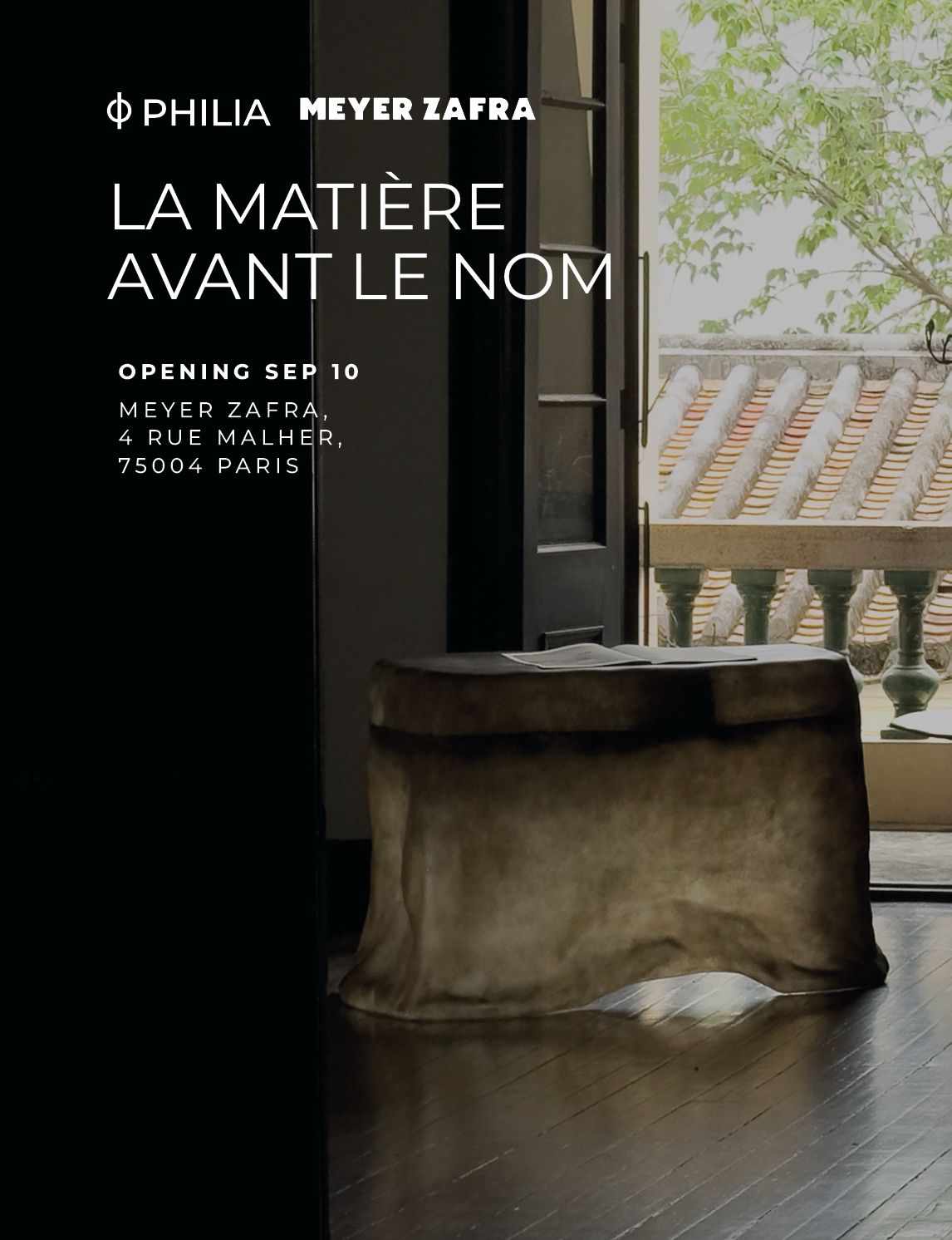
On the occasion of Paris Design Week, Galerie Philia and Espace Meyer Zafra present La matière avant le nom, a dialogue between the creations of Kar, the ceramics of Louise Traon, and works by Manuel Mérida, Francisco Salazar, and Anaïs Vindel.
A chair, a table, a vase, a painting: each object seems at first to be assigned a name, a function, a place. This exhibition begins at the very moment when these certainties begin to unravel.
In the work of Kar, the fiberglass pieces from the Formless collection retain their function, yet still seem imbued with the gestures that shaped them. Their irregular surfaces and supple volumes evoke, in turn, rock, clay, or a substance slowly transformed by time. The furniture never fully closes in on its function. It remains on the threshold of sculpture, as though it could still become something else.
The ceramics of Louise Traon bring this process of becoming back to its earthly origins. In her glazed stoneware, wild clays, ashes, granite, and chalk are not merely materials: their properties actively contribute to the emergence of forms and colors. The hand works alongside a material whose reactions it can never entirely control.
This same indeterminacy runs through the works brought together by Espace Meyer Zafra. In Manuel Mérida’s work, matter shifts and continually redistributes the composition: the work never settles into a definitive image. Francisco Salazar turns white relief into a space where light, shadow, and the movement of the viewer’s gaze constantly transform perception. In Anaïs Vindel’s paintings, color opens onto depths without a defined horizon, at the threshold between landscape, memory, and apparition.
From one work to the next, painting acquires volume, furniture becomes almost an image, and ceramics retain the memory of earth and fire. Synthetic matter appears mineral or organic. Between surface and depth, use and contemplation, categories become momentarily uncertain.
La matière avant le nom refers to that moment when what we are looking at is not yet quite a piece of furniture, a painting, or a sculpture. Not a world without distinctions, but a world in which things remain open enough to still be named otherwise.