Ceramics as witness: A research in investigative design
Gongjie Liu
Background
What comes to mind when we think of ceramics? Perhaps ornate imperial wares: exotic imports steeped in Oriental mystique, widely circulated across pre-globalisation maritime routes and long regarded as symbols of power and status. Yet this is but a fleeting chapter in its long history. Over the centuries, it settled into the quiet fabric of everyday life: a vessel for milk, hot soup, a bracing cup of afternoon tea. Charming, isn’t it? Drop one, and all that warmth curdles in an instant: a scolding, a stinging backside, a whole day of guilt. In this sense, a ceramic piece can be a litmus test for a parent’s kindness, or a quiet lesson in how quickly things can unravel. Ceramics is, above all, a shape-shifting medium. Across cultures and geographies, it endures as a vital carrier of civilisation – holding a fragment of history, a vessel for story, a conduit for radical ideas. Perhaps such is the nature of the medium: in different hands, across different eras, it bears entirely different weights.
Prelude to the Research
My entry into the world of clay was entirely accidental. Previously, as an interdisciplinary designer, I worked through moving image practice to explore issues of ecology and technological governance, my life perpetually shifting between cities. Two years after completing my postgraduate studies, I moved to Shanghai, yet I never managed to feel at home with the life there. Shanghai is a city of modernisation but without modernity: restlessly prosperous yet permeated by a sense of rootlessness, it defies definition within either Eastern or Western frameworks of understanding. As life descended into suspension, the heavy weight of modernist rationality, compounded by the rift between the local and the global, eroded the very meaning of home and ideal. These tensions congealed into a feeling I call swelling – indefinable, unresolvable through institutional change, and beyond the reach of shared language. It eventually gave rise to a prolonged, sweltering melancholy.
My residency in Jingdezhen marked a turning point. At first, I saw it merely as a step for professional advancement, but day after day of working with clay quietly transformed something within me. The multisensory details of the craft replenished my perceptual dimensions and settled my mind. This thousand-year-old city, built on porcelain, has its industrial logic woven into the fabric of daily life, fostering a quality of life defined by quiet absorption and dedication.
I worked alongside all kinds of practitioners and came to understand deeply that craft is rooted in the soil of everyday life, interwoven with routine and aspiration. Master craftspeople told me that good work is the result of constant negotiation with the kiln fire, and that worshipping the kiln god is an act of reverence for the uncertainties that lie beyond craft itself. Yet Jingdezhen too is in the throes of transformation. Amid the accelerating impact of new industries and technologies, everyone is asking: how can a craft that carries the warmth of old times keep pace with the upheavals of the present? There is no standard answer to this question.
As I too became one of those who labour day and night, coming to understand success and failure through repeated firings and waiting, clay had long ceased to be merely a material for creation – it had become a companion in life. Those questions about our times and about craft lingered constantly in my mind, and eventually led me to the idea for this research: to work with clay, and through clay, to do something of real meaning.

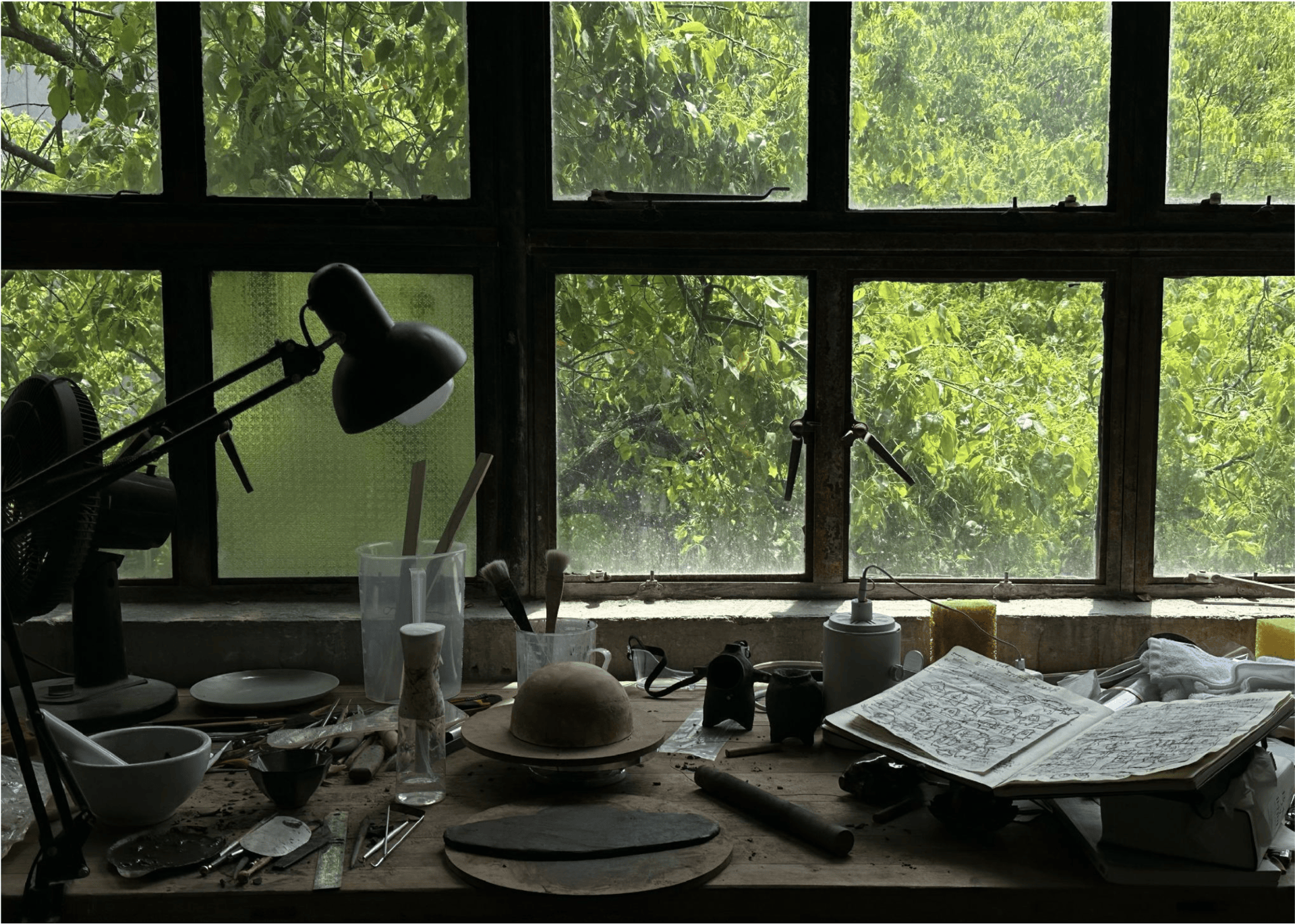
The workbench for the residency in Jingdezhen (located within the Sculpture Ceramics Factory)
My Research Project
In London, my research began with the collection of clay samples. It was not guided by any predefined research question, but grew from a simple curiosity: to “follow the clay and see what unfolds”. London is a city both familiar and strange to me, and the selection of sampling sites has always been closely tied to the neighbourhoods where I used to live. Often caked in mud, I would meet old friends to catch up on years of change, collecting samples from nearby spots in between our conversations. On this basis, I also consciously balanced sample coverage across different urban functional zones, including industrial, commercial and residential areas. This interplay between personal life trajectories and urban zoning typology allowed my sample archive to grow steadily and organically.
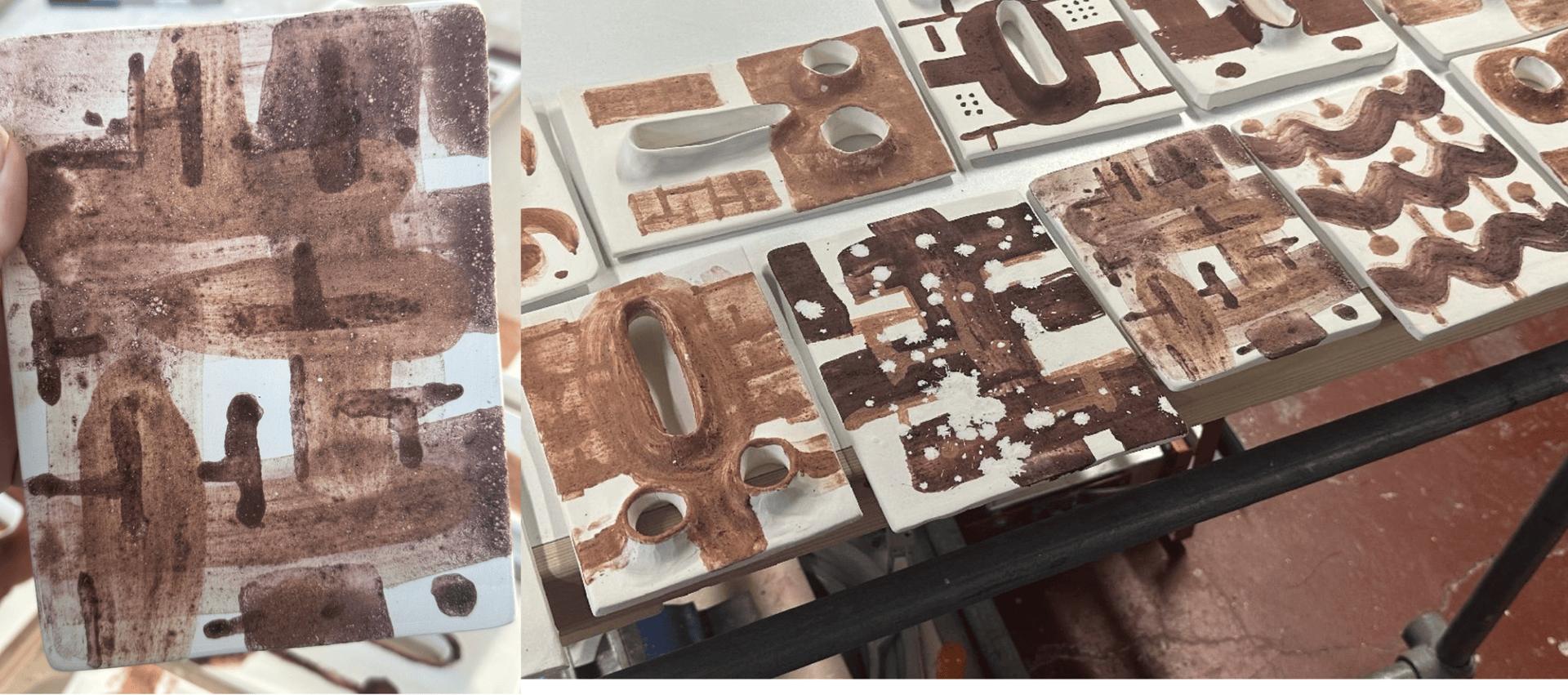
All samples were sent to the Ceramics Workshop at Goldsmiths for standardised processing. With access to fully equipped facilities, I was able to explore a range of processing and experimental approaches: air-drying specimens naturally to observe cracking patterns, grinding clay into powder for glaze formulation, and preparing clay slips at varying ratios for gradient firing trials. The clay collection phase spanned several months and was an immensely fulfilling period that also included engagement with the doctoral community and training in research methodologies. As winter set in, I shifted the core focus of my practice to slip experiments. During one particular test, a sample from Mudchute Farm on the Isle of Dogs immediately stood out: the fired piece developed a deep, saturated purple hue – a stark departure from the typical ochre and pale yellow tones characteristic of native London clay after firing.

Mudchute Farm - Isle of Dogs - London
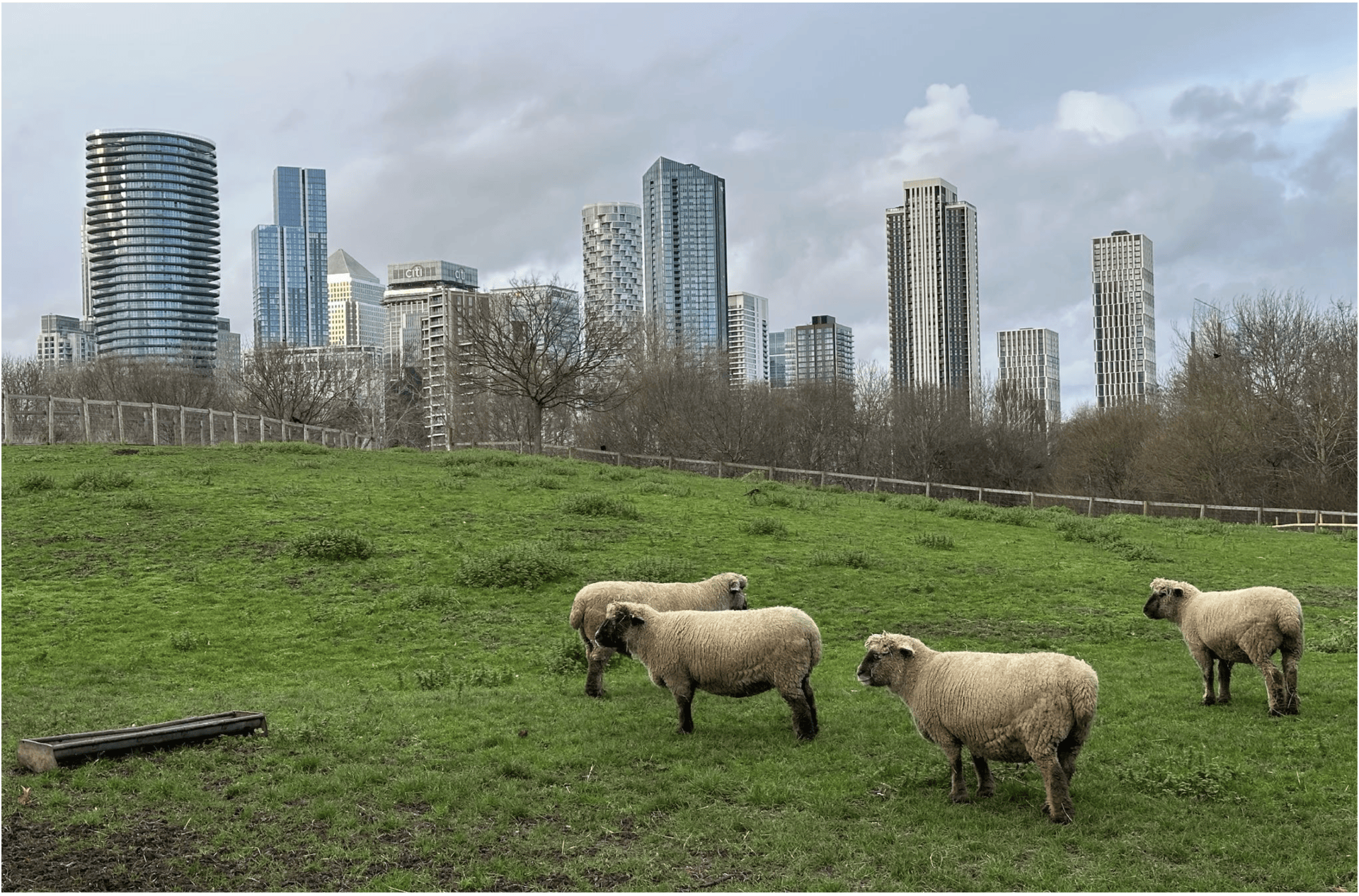
Based on established empirical principles of ceramic colour development, such an anomalous purple tint generally points to excessive accumulation of manganese in the soil. This came as a considerable surprise: why would such a high density of heavy metals build up in a green space operated as an urban farm? The neat, well-maintained appearance of the site observed during field visits contrasted sharply with the firing results, and thoroughly ignited my drive to investigate further. I subsequently returned to the area multiple times to collect supplementary samples from surrounding locations.
Repeating the process with identical preparation protocols and kiln parameters consistently yielded highly uniform colour results across all specimens. I then visited the Isle of Dogs Waterway Museum, where archival materials trace the area’s full historical trajectory: from an early colonial trading port, to a hub of heavy industry and shipbuilding, to the international financial district it is today.
This historical clue led me to narrow my research focus to soil contamination left over from the industrial era. To test this hypothesis, I accessed publicly available borehole and sampling reports for the London area from the British Geological Survey (BGS), retrieved deep soil test data for the locality, and mapped the locations of key historic shipyards and industrial sites, overlaying both datasets onto a single cartographic map. I also commissioned professional heavy metal analysis of the samples, and the quantitative findings aligned fully with the qualitative observations from the firing colour tests.
Ultimately, through the cross-corroboration of four independent lines of evidence – material experimental data from ceramic firing colour tests, industrial historical context from local archives, soil composition data from geological boreholes, and quantitative results from professional heavy metal analysis – I was able to identify the most likely historical source of the contamination: the manganese enrichment in the soil at Mudchute Farm originates from the 19th- and 20th-century shipbuilding and steel industry cluster centred on J. Scott Russell & Co. and Millwall Iron Works. A core alloying element in steel production, manganese was deposited into the soil via industrial waste, dust, and wastewater, accumulating over a hundred years to form this heavy metal legacy beneath the surface.

Fired clay samples. Purple colouration indicates elevated manganese levels in the source soil
The Problem of Diffuse Slow Violence
This research remains in its early stages. Even so, the investigation and findings from the Isle of Dogs open up some valuable lines of discussion: it would be inaccurate to claim that clay has helped uncover new scientific facts, per se. The ecological and health risks posed by heavy metal enrichment in industrial soils have long been widely discussed in the global field of brownfield governance. In my view, the value of this research lies not in advancing environmental science conclusions, but in offering a mode of pluralistic cognition and early warning that allows us to recognise forms of violence obscured by standard governance frameworks. As defined by Rob Nixon, this is slow violence, typically marked by three core features: non-eventfulness, spatial diffuseness, and ambiguous accountability.
In the Isle of Dogs case, contamination is the gradual accumulation of a century of shipping, shipbuilding, and heavy industrial activity, with no single point of origin or catastrophic event. Heavy metals are mixed into the soil and buried underground, rendering them invisible to everyday perception. The industrial operations of the past have long since closed or relocated amid structural urban change, rendering traditional judicial accountability mechanisms entirely ineffective and allowing harm to persist in a state of systemic unaccountability.
During this investigation, I drew on the cross-mapping evidentiary methodology developed by the Forensic Architecture research group at Goldsmiths. In contrast to the strict demands for closed-loop causality in traditional judicial evidence systems, this approach prioritises contextual correlation and mutual corroboration, and recognises the discursive value of even imperfect evidence. The deep purple hue revealed after firing is a case in point: while it cannot match the precision of professional heavy metal analysis, it acts as a vehicle for pluralistic fact-making, compensating for the communicative limits of abstract numerical data through direct sensory impact. As one link in the chain of contextual causal evidence, it brings the subterranean ecological debts overlooked in everyday life back into public discourse.
In my view, the real difficulty of slow violence lies in its invisibility and the absence of an accountable subject. It haunts us like a spectre: it lacks the spectacular events that capture media attention, and it is difficult to pursue accountability through existing institutional channels. This existence beyond ordinary sensory perception allows it to recede into the background of public consciousness. When I look back at the series of “swelling” sensations I experienced in Shanghai, that chaos and turbulence seem to stem from the epistemological violence of instrumental rationality, which forces the rift between global and local ways of life deep into individual lives. We rush from one mundane task to the next, consumed by anxiety and the imperative of future-oriented desire, and lose the tactile capacity to feel, reflect and define our own experience. This kind of suffering cannot be resolved by a single institutional reform. What is needed, instead, is a stance of redefining problems themselves, supported by a diverse discursive commons – a path that may allow us to break free from these overwhelming mental burdens.
Investigative Design
Drawing on my background as a designer with professional industry experience, I am accustomed to approaching such issues from a design context. Yet established design paradigms have consistently struggled to accommodate these diffuse, long-running issues with ambiguous accountability. For decades, designers have been shaped by economic structures and industrial production systems into highly specialised agents: the vast majority of practice unfolds through commercial commissions, centred on delivery for implementation, mass-production compatibility and utility maximisation, following a result-driven logic of delivering standardised solutions to predefined problems. Even critical approaches such as Speculative Design, which attempt to break free from the pragmatist framework, often end up trapped in the cultural games of elite circles. The recent exhibition In Other Worlds at London’s Barbican Centre is a case in point:
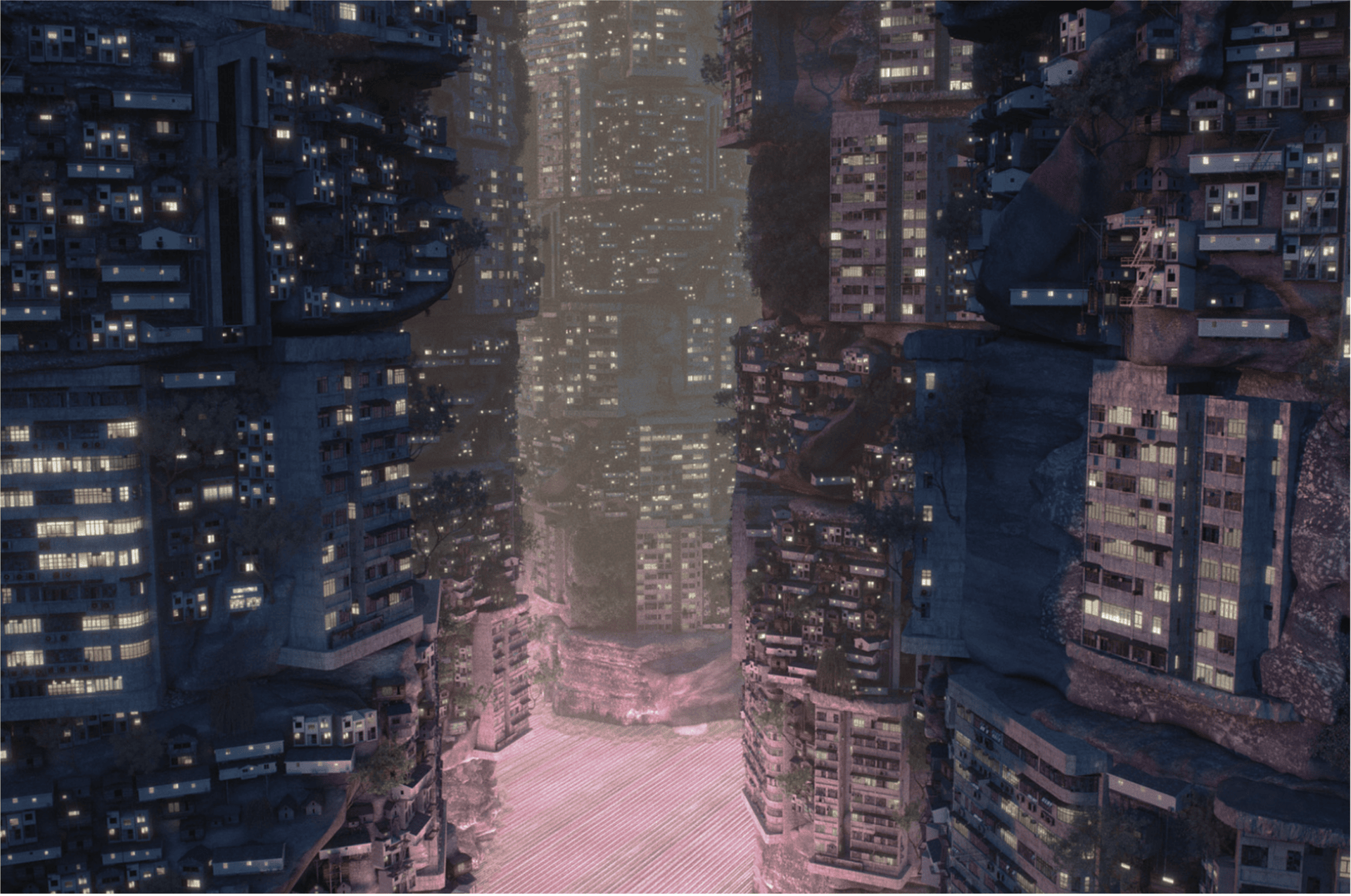
Creator Liam Young constructs deeply unsettling visions of a high-tech future through highly charged neon aesthetics, high-precision models and AI-generated imagery. In my view, Young’s work is extremely sophisticated in both narrative and visual execution. Yet stripped of its visual innovation, its symbolic system is essentially derived from the Hollywood cyberpunk visual industry template. What appears to be a radical future narrative is in fact a mode of expression already domesticated by the mass cultural industry. Running through his body of work is what might be called an “eco-modernist myth”: from Planet City’s vision of high-density habitation that transcends planetary boundaries through technology, to The Great Endeavour’s narrative of techno-fix offsetting carbon emissions via atmospheric restoration projects, to Emissary’s grand narrative of human immortality proclaimed through a civilisational heritage spacecraft. The works consistently advance techno-utopian narratives, while evading the structural roots of climate change. This visually stunning exhibition risks instead providing aesthetic packaging for techno-optimism and neoliberal extractivist logic, co-opted by systems of power as a cultural buffer to perpetuate the status quo.

Planet City, artwork by Liam Young. Image sourced from online public sources
I do not intend to dismiss the positive value of the entire field through a single case, but the limitations of exhibition-based academic practice when confronted with concrete real-world problems are evident. This calls for a turn towards a more effective path – a genuinely activist approach to design.
In its core orientation, Investigative Design fundamentally departs from the service-agent role of traditional design. Rather than passively taking on commissions and ending with the closed-loop delivery of solutions, it adopts a deliberate critical stance to proactively trace the hidden issues latent within technological systems and environmental structures. It intervenes deeply in the full process of how issues emerge and evolve, ultimately achieving systematic articulation and the public articulation and exposure of these problems. At the level of practical methodology, Investigative Design does not presume a single standard answer, nor does it submit to fixed factual frameworks. Instead, it actively draws intellectual resources from existing paradigms across disciplines, including the evidence-construction methods of Forensic Architecture and the path of material-driven embodied practice. Investigative Design is distinct in two key ways:
First, it differs fundamentally from Forensic Architecture in its core purpose. Forensic Architecture centres its practice on the revelation of violence within a judicial context, focusing on building evidential frameworks that serve judicial accountability and public debate, ultimately pointing towards the identification of responsibility and legal redress for specific actors. Investigative Design, by contrast, focuses on slow violence. It emphasises long-term on-site tracing by designers and through immersive, sustained field and material research, develops deep interpretations of diverse, heterogeneous factual dimensions. At the same time, it frames all discussion within the overarching framework of planetary thinking, ultimately aiming to stimulate public discourse and critical action rather than narrow judicial accountability.
Second, it follows a completely different research logic from material-driven embodied practice. Material-driven design research takes material itself as its core object, dedicated to expanding the application boundaries of materials and exploring their expressive and aesthetic possibilities. For such approaches, material is both the starting point and the final output of research. Investigative Design, by contrast, positions material practice as a methodological tool for tracing. It leverages the material properties of substances to anchor specific observational perspectives, guide the trajectory of investigation, and establish concrete modes of intervention. The entire practice ultimately points to the hidden issues latent within technology and the environment; material is thus a carrier of method, not the end point of research.
Looking back at the Isle of Dogs field research case: it was precisely by leveraging the colour-developing property of clay when fired with heavy metal oxides in soil that I was able to transform pollutant residues imperceptible to the naked eye into clear, tangible visual evidence, uncovering hidden environmental facts obscured by everyday experience. This investigative stance – rooted in the field rather than relying on exhibition – along with the material methodology it generates, will continue to evolve and expand in future research. In the face of unresolved issues, deepening the exploration of clay’s material properties to continuously open up new dimensions of investigation and spaces for intervention is precisely the most promising aspect of this research.
As a practical path that fosters activism, situating it within a planetary frame of reference is inherently appropriate. This means it neither adheres to the discursive games of sovereign states, nor submits to the homogenising logic of techno-universalism. Instead, it takes common materiality as its medium, enabling equal dialogue between ecological legacies, local histories and governance experiences across different regions. Ultimately, all of this is anchored in a humble stance of dwelling: we are not observers or dominators standing outside the Earth, but part of the material flows of geological cycles, deeply embedded within them. We share one planetary fate with the soil beneath our feet, the minerals in the strata, the flames in the kiln, all unfamiliar fellow humans and non-human species, and the mountains, rivers, land and sky.
SHARE :