
Stone
Stone is one of the oldest and most influential materials in the history of architecture, interiors and object design. Formed through geological processes over millions of years, it offers a unique combination of durability, structural performance and natural beauty that few materials can equal. Its immense variety of colours, textures and mineral compositions has allowed civilizations across the world to build monuments, shape cities and create objects that endure for centuries.
Today, stone continues to play a defining role in contemporary design. Architects and designers value it not only for its technical qualities, but also for its ability to introduce permanence, tactility and subtle natural variation into modern spaces. From monumental architecture to collectible furniture, stone remains one of the essential materials through which designers express craftsmanship, authenticity and timelessness.
Introduction
History
Characteristics
Applications
Contemporary Relevance
Introduction
Stone is one of humanity’s oldest building materials and remains one of the most significant in contemporary architecture, interiors and collectible design. Formed over millions of years through geological processes, natural stone embodies permanence, structural integrity and an extraordinary diversity of colours, textures and mineral compositions. Unlike manufactured materials, every block of stone is unique, carrying subtle variations that reflect its geological origin and the environmental conditions under which it was formed.
Throughout history, civilizations have relied on stone to construct monuments, religious buildings, civic architecture and domestic spaces capable of enduring for centuries. While its historical importance is undeniable, stone is far from being a material confined to the past. Advances in quarrying, cutting, finishing and engineering have transformed its possibilities, allowing architects and designers to explore new forms, thinner applications and increasingly sophisticated combinations with glass, wood, metal and concrete.
Today, stone occupies a unique position within contemporary design. It provides a sense of permanence in increasingly ephemeral environments while introducing tactile richness, visual depth and a direct connection to the natural world. Whether carved into sculptural furniture, integrated into minimalist interiors or employed as the defining element of monumental architecture, stone continues to demonstrate a remarkable ability to evolve without losing the qualities that have made it indispensable for thousands of years.
Origins and Geological Formation
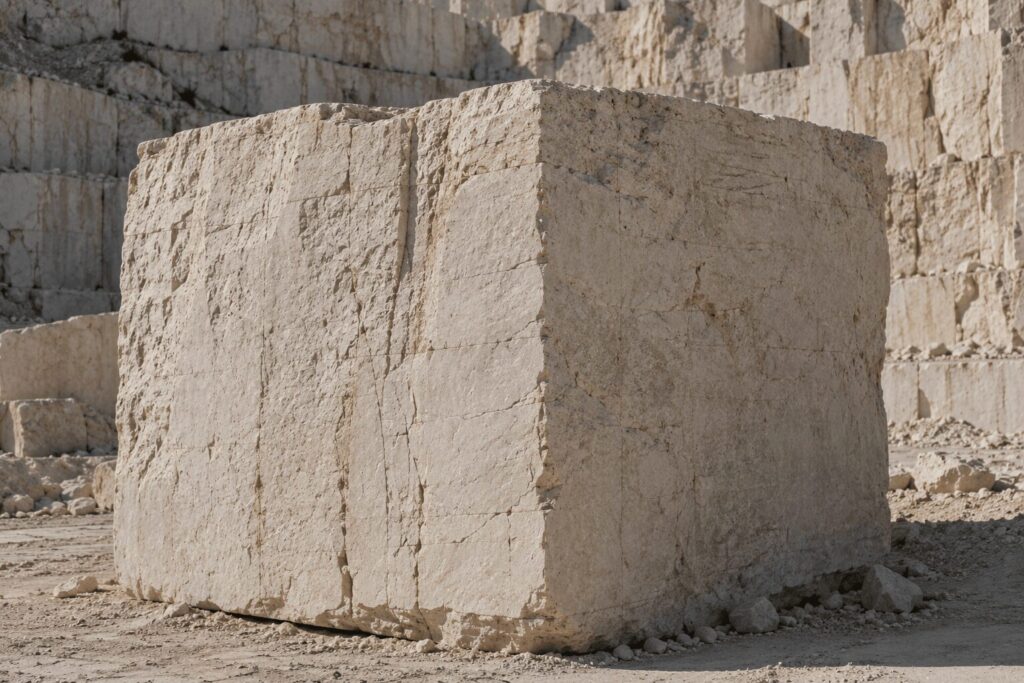
Natural stone is the result of geological processes that have shaped the Earth’s crust over millions, and sometimes billions, of years. Unlike engineered materials, it is not manufactured but extracted directly from naturally occurring rock formations, making every slab or block inherently unique. Its appearance, mineral composition and structural properties are determined by the conditions under which it formed, including pressure, temperature, sedimentation and volcanic activity.
Geologists generally classify natural stone into three principal families: igneous, sedimentary and metamorphic. Igneous stones, such as granite and basalt, originate from cooled magma or lava and are valued for their exceptional density and strength. Sedimentary stones, including limestone and travertine, develop through the gradual accumulation of mineral deposits and organic matter, often preserving visible layers or fossil traces that reveal their geological history. Metamorphic stones, such as marble, begin as existing rocks that are transformed by intense heat and pressure, creating new crystalline structures and distinctive veining.
These geological origins explain why no two pieces of natural stone are ever truly identical. Variations in colour, grain, porosity and mineral inclusions are not imperfections but intrinsic characteristics that distinguish natural stone from industrially manufactured materials. Rather than seeking absolute uniformity, architects and designers increasingly celebrate these variations as evidence of authenticity and material integrity.
Once extracted from the quarry, stone undergoes a series of mechanical processes including cutting, calibration, finishing and, when necessary, structural reinforcement. Modern fabrication technologies now allow exceptionally thin stone panels, precision-cut components and complex sculptural forms that would have been impossible only a few decades ago. These advances have significantly expanded the material’s applications while preserving the visual richness that has defined stone throughout history.
Characteristics and Properties
Natural stone combines structural performance with an exceptional visual and tactile richness, making it one of the most versatile materials available to architects and designers. Its appeal lies not only in its durability but also in the subtle variations that distinguish every piece. Differences in mineral composition, geological formation and finishing techniques create surfaces that can appear polished and reflective, softly honed, textured or dramatically split, allowing stone to adapt to a wide range of architectural and decorative applications.
One of stone’s defining characteristics is its longevity. Many natural stones withstand centuries of use while developing a surface patina that records the passage of time rather than concealing it. Unlike synthetic materials that often deteriorate uniformly, stone frequently gains visual depth as it ages, reinforcing its association with permanence and authenticity. This ability to evolve gracefully explains why historical buildings and contemporary interiors alike continue to rely on natural stone as a primary material.
Mechanical performance varies considerably depending on the type of stone. Granite is valued for its hardness and resistance to abrasion, making it suitable for heavily used surfaces. Marble, while generally softer, offers exceptional workability and a distinctive crystalline appearance that has made it one of the most celebrated materials in sculpture and architecture. Limestone and travertine provide a softer visual language with warmer tones and a more porous structure, qualities that are often appreciated in residential interiors and hospitality projects. Understanding these differences is essential when selecting the appropriate material for a specific application.
Equally important is the way stone interacts with light. Polished finishes reflect light and emphasise veining, while honed and brushed surfaces absorb light more softly, revealing texture without excessive contrast. Split-face or bush-hammered finishes introduce shadows and tactile variation that enhance architectural depth. These finishing techniques allow designers to influence not only the appearance of a surface but also the atmosphere of an entire space.
Natural variation remains one of stone’s greatest strengths. Veins, fossils, mineral inclusions and tonal shifts are inherent characteristics rather than defects. Increasingly, contemporary design embraces these irregularities as expressions of geological history and individuality, moving away from the pursuit of absolute uniformity. In this sense, every slab becomes a singular material composition that cannot be perfectly replicated.
Finally, stone requires thoughtful specification and maintenance. Factors such as porosity, stain resistance, weather exposure and structural load influence where and how a particular stone should be used. When properly selected, fabricated and maintained, natural stone offers an exceptional balance of durability, repairability and timeless aesthetic value, qualities that continue to distinguish it from many engineered alternatives.
Stone in Architecture and Interiors
Few materials have shaped the built environment as profoundly as natural stone. From the earliest megalithic structures to contemporary residential architecture, it has remained a constant presence, valued not only for its structural performance but also for its capacity to define atmosphere, proportion and permanence. While construction techniques have evolved dramatically over the centuries, stone continues to offer qualities that many modern materials struggle to replicate.
In contemporary architecture, stone is increasingly used to create environments that feel calm, enduring and deeply connected to their surroundings. Rather than serving solely as a structural material, it often becomes a spatial element that influences how light is reflected, how sound is absorbed and how surfaces are experienced through touch. Large-format slabs, continuous flooring and precisely detailed wall cladding allow architects to minimise visual interruptions, creating interiors that emphasise material continuity rather than decoration.
The relationship between stone and natural light plays a particularly important role in contemporary design. Throughout the day, changing sunlight gradually reveals mineral inclusions, subtle veining and surface textures that remain invisible under artificial illumination alone. Honed finishes diffuse light softly, while polished surfaces introduce controlled reflections that can visually expand a space without overwhelming it. This dynamic interaction explains why stone often appears different from morning to evening, giving interiors a constantly evolving character.
Stone also contributes to architecture through its physical presence. Unlike lightweight materials that often disappear into the background, natural stone introduces a sense of mass, stability and permanence. Floors, staircases, fireplaces, monolithic kitchen islands and sculptural bathrooms become architectural anchors that organise the surrounding space rather than simply occupying it. In minimalist interiors, where decorative elements are intentionally reduced, the expressive qualities of the material itself frequently become the primary source of visual interest.
Another defining characteristic of stone is its ability to establish continuity between interior and exterior environments. The same limestone floor may extend seamlessly from a living room onto a terrace, while matching stone walls blur the distinction between architecture and landscape. This continuity reinforces the connection between built spaces and their natural context, an approach that has become increasingly prominent in contemporary residential architecture.
The emotional qualities of stone are equally significant. Designers often describe it as a material that conveys calm, authenticity and permanence. Its naturally occurring imperfections—veins, fossils, tonal variations and subtle irregularities—introduce a level of visual complexity that cannot be reproduced by industrially manufactured surfaces. Rather than competing with furniture, artworks or natural light, stone provides a restrained yet expressive background that allows other elements within an interior to coexist harmoniously.
Today, architects continue to reinterpret stone through new fabrication technologies, thinner assemblies and increasingly sophisticated detailing. Yet despite these technical innovations, the material’s enduring appeal remains rooted in the same qualities that have defined it for thousands of years: authenticity, longevity and an extraordinary capacity to connect architecture with the geological history of the landscape from which it originates.
Stone in Collectible Design
While stone has traditionally been associated with architecture and monumental construction, its role within collectible design has expanded dramatically over the past three decades. Advances in digital fabrication, CNC milling and precision stone cutting have enabled designers to work with natural stone in ways that were previously impractical, transforming a historically structural material into a medium for experimentation, artistic expression and limited-edition furniture.
In contemporary collectible design, stone is rarely treated as a neutral surface. Instead, it becomes the central subject of the object itself. Designers deliberately embrace its weight, geological history and natural variation, allowing each piece to retain a strong sense of material identity. Rather than concealing veins, fossils or mineral inclusions, these characteristics are often positioned as defining visual elements that ensure every edition remains inherently unique.
The dialogue between stone and other materials has become one of the defining themes of contemporary furniture design. Bronze introduces warmth and precision, wood softens the visual density of monolithic forms, while glass creates a sense of lightness that contrasts with the material’s physical mass. These carefully balanced combinations allow designers to preserve the expressive power of stone while expanding its formal possibilities.
Equally important is the relationship between craftsmanship and technology. Although advanced machinery now enables remarkable precision, the final character of a stone object still depends heavily on human expertise. Selecting the appropriate block, determining how veins should be oriented, choosing a surface finish and refining edges all require decisions that cannot be reduced to purely technical processes. As a result, each object reflects both the geological history of the material and the craftsmanship involved in revealing its final form.
Stone has also encouraged designers to reconsider proportion and perception. Large monolithic volumes may appear unexpectedly light through careful detailing, while seemingly fragile forms can retain remarkable structural stability. This constant dialogue between visual weight and physical balance has become a defining characteristic of many contemporary collectible pieces, where stone is valued not only for its durability but also for its ability to challenge expectations.
Today, natural stone occupies a central position within collectible design because it offers something increasingly rare: authenticity. In an era dominated by industrial standardisation, every slab remains impossible to reproduce exactly. Designers therefore work not against the individuality of the material but with it, allowing geological variation to become an integral part of each object’s identity. The result is furniture and sculptural objects that possess a permanence extending beyond function, connecting contemporary design with the slow timescales through which the material itself was formed.
Sustainability and Contemporary Relevance
Despite the continuous development of engineered materials and advanced composites, natural stone remains one of the most relevant materials in contemporary architecture and design. Its enduring appeal is not driven by nostalgia but by a combination of environmental, aesthetic and technical qualities that continue to resonate with architects, designers and collectors seeking materials capable of outlasting changing trends.
One of stone’s greatest strengths lies in its exceptional longevity. Buildings and objects crafted from natural stone frequently remain in use for generations, often requiring only minimal maintenance throughout their lifespan. This durability reduces the need for replacement and contributes to a slower, more sustainable approach to construction and design. Unlike many manufactured materials that deteriorate beyond repair, stone can often be refinished, repolished or repurposed, extending its useful life far beyond that of many contemporary alternatives.
Environmental considerations have also transformed the way natural stone is specified. Designers increasingly evaluate the origin of materials, quarrying practices, transportation distances and fabrication methods alongside aesthetic criteria. Many quarries now operate under stricter environmental regulations, invest in water recycling systems and implement restoration programmes aimed at reducing the long-term impact of extraction. At the same time, architects often favour locally sourced stone to reduce transport-related emissions while reinforcing connections between architecture and regional geology.
Technological innovation continues to expand the possibilities of natural stone without altering its essential character. Ultra-thin stone veneers, lightweight composite-backed panels, advanced CNC machining and precision digital fabrication enable designers to achieve forms that would once have been technically impossible. These developments allow stone to be used in applications where weight, complexity or installation constraints previously limited its adoption.
Beyond performance and sustainability, stone responds to a broader cultural shift toward authenticity and permanence. As digital technologies increasingly dominate everyday life, many designers seek materials that offer tactile richness, visible imperfections and a tangible connection to natural processes. Stone satisfies this desire through its geological history, its inability to be perfectly replicated and its capacity to age with dignity rather than simply deteriorate.
For these reasons, natural stone continues to occupy a unique position within contemporary design. It is simultaneously ancient and innovative, familiar yet endlessly variable, technically advanced while remaining deeply rooted in nature. Rather than being replaced by newer materials, stone has continually adapted to changing architectural languages, proving that true material relevance is measured not by novelty but by the ability to remain meaningful across generations.
Frequently Asked Questions
What is considered natural stone?
Natural stone refers to rock that is extracted directly from the earth and processed into usable slabs, blocks or components without altering its fundamental geological composition. Unlike engineered stone or ceramic materials, natural stone retains the mineral structure, colour variation and surface characteristics created through natural geological processes over millions of years. Common examples include granite, marble, limestone, travertine, slate and basalt.
What is the difference between natural stone and engineered stone?
Natural stone is quarried directly from geological formations, making every slab unique in colour, veining and texture. Engineered stone is manufactured by combining crushed stone with resins and pigments to produce a more uniform appearance. While engineered materials can offer consistency and lower maintenance, natural stone is valued for its authenticity, individuality and ability to develop character over time.
Is natural stone suitable for contemporary interiors?
Yes. Although stone has been used for thousands of years, it remains one of the defining materials of contemporary architecture and interior design. Advances in fabrication techniques allow it to be used in large-format flooring, wall cladding, sculptural furniture, bathrooms and kitchens, as well as collectible design. Designers often combine stone with wood, metal and glass to create spaces that feel both timeless and modern.
Does natural stone require a lot of maintenance?
Maintenance requirements depend on the specific type of stone and its finish. Some porous stones benefit from periodic sealing to reduce staining, while denser materials such as granite generally require less protection. Regular cleaning with pH-neutral products and appropriate care allow natural stone to maintain its appearance for decades, and many surfaces can be refinished if necessary.
Why do designers continue to choose natural stone?
Designers value natural stone because it combines structural durability with exceptional visual richness. Every piece is unique, offering variations in colour, veining and texture that cannot be reproduced industrially. Beyond its technical performance, stone introduces permanence, tactility and a direct connection to nature, qualities that remain highly relevant in contemporary architecture and collectible design.
References
Ashurst, John & Dimes, Francis G.
Conservation of Building and Decorative Stone.
Butterworth-Heinemann.
Siegesmund, Siegfried & Snethlage, Rolf (eds.).
Stone in Architecture: Properties, Durability.
Springer.
Natural Stone Institute.
Technical Library and Stone Resource Collection.
Getty Conservation Institute.
Conservation and Stone Heritage Resources.
ICOMOS – International Council on Monuments and Sites.
Stone Conservation Principles and Heritage Documentation.
Picon, Antoine.
French Architects and Engineers in the Age of Enlightenment.
Cambridge University Press.
Kenneth Frampton.
Studies in Tectonic Culture.
MIT Press.
Adrian Forty.
Materials.
Dans Words and Buildings: A Vocabulary of Modern Architecture.
Thames & Hudson.