Cobra Studios
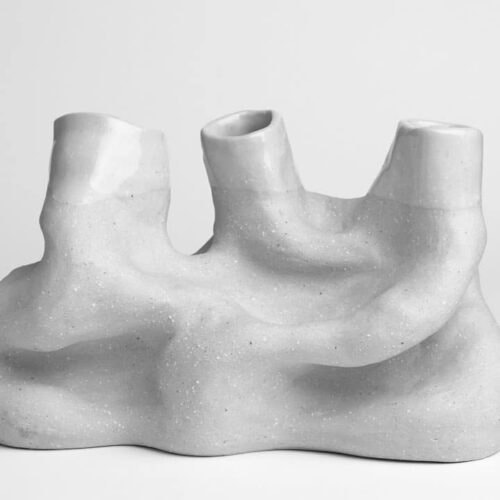
Cobra Studios is a multidisciplinary design practice working across collectible design, interiors, and creative direction. Through a sculptural approach to form and materiality, the studio creates furniture and objects that balance artistic expression with functionality.
Drawing inspiration from architecture, craftsmanship, and contemporary culture, Cobra Studios develops bold and tactile works that blur the boundaries between art and design, resulting in pieces with a distinctive and enduring presence.
Interview
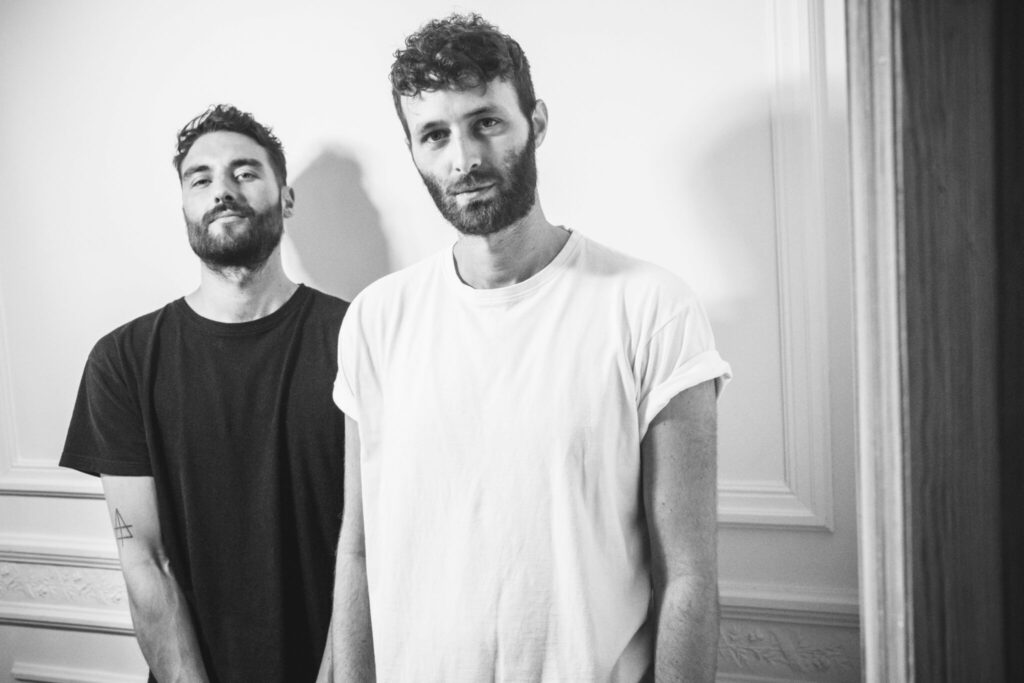
Kenny: Born in Bruges, Belgium. I left Belgium after my studies to go and work in Paris, where I met Hugues.
Hugues: Born in Caen, Normandy. I studied in Paris. Hugues works mainly out of Paris, and Kenny mainly out of Brussels. We spend our weekends together.
Kenny: My first memory is a visit to the Notre Dame-du-Haut in Ronchamp when I was 15 years old. Until that moment I always had the impression that architecture was functional and did not have an extra layer, granted I was still a young bird. The chapel designed by Le Corbusier thought me another language in architecture. You can break loose from the « standardized » world and create distinctive pieces/buildings. The intimacy, the claire-obscure, the small windows that work like light fixtures,… So many ideas brought together that in a bizarre way work perfectly.
Hugues: I spent my holidays at my uncle’s house when I was a child. He was a collector; his “maison bourgeoise” was full of nice objects, paintings, and design furniture. But my first connection was when I studied the Villa Cavrois by Robert Mallet-Stevens. I was impressed by the elegance and the simplicity of this modernist architecture.
Kenny: I studied architecture and Civil engineering at the University of Ghent, Belgium. After my studies, I moved to Paris for two reasons: 1. Where can you better develop architecture and art than in one of the most beautiful cities in the world? 2. I really needed to learn French… I started working as an Architect and have been doing this for the past 12 years.
Hugues: I studied “les arts plastiques and scenography” in Paris.
Then I started to work in the luxury fashion industry as a visual merchandiser & set designer. For sure, fashion has always been connected to art & design. It’s inspirational.
It’s actually because of the place where we live right now. We moved to a new apartment on the ground floor of a city mansion in Brussels. The building was once owned by the Belgian painter Franz Kegeljan, who in 1910 commissioned the architect Paul Saintenoy to build a private mansion in the Louis XV style. In the first six months, we had to get used to the height of the ceilings. We came from a small student flat. Our furniture looked tiny, as if it came out of a dollhouse.
We were always in awe when sitting on the sofa, the height of the ceiling (5,6m high) is quite imposing.
This vast interior eventually motivated us to design our own furniture. An ambition that Kenny had been harbouring for some time, as he worked together with Perrault on the furniture of the National Library in France. It sort of also had to do with some frustration we had. We couldn’t find the table we wanted, and certainly not on a limited budget, so we designed it ourselves. Coming from two different worlds (architecture vs fashion), we found out that we are very complementary in creating design objects. It came very naturally. At one point, we made the decision not to buy any furniture but to just design it all ourselves.
It’s actually very eclectic. The Marcello mirrors are based on the potato shapes of 1960’s mirrors. These used to be at the house of Hugues’ grandmother, Marcelle (hence the name).
We always look for contrast in materials, colour,… At one point, they were redoing the paving of our street. We grabbed pieces of asphalt because we loved the texture and decided to recreate a tabletop.
We have also found reflector lights in a garbage pile next to a highway. We loved the design and are now trying to recreate a piece with this object in the back of our mind.
In all fairness, we never had a specific assignment to design something. We pick up elements from our daily life that we find, mostly unconventional, and try to rework those into a “design” element.
We both have a full-time day job. Our jobs are quite stressful and don’t allow us much time for creativity during the day. We missed this creativity, sometimes we can’t wait to stop our daily job, go to the atelier and pass an entire night designing pieces, taking a chainsaw and start carving pieces,… We needed something we could do with our own hands. It sort of frees our minds.
We sort of bumped into it. We thought that the usual furniture scene was quite boring. Everything is in wood, metal, or stone. We wanted to create colourful pieces that can brighten up a bland room. We wanted to have a glass-like finish, create transparency when we wanted it to, or be fully opaque if that was our wish. The moment you know how resin works, the possibilities are endless. We are currently trying fabrics and soft materials, aluminium, stones,… But we always try to let it collaborate with resin elements.
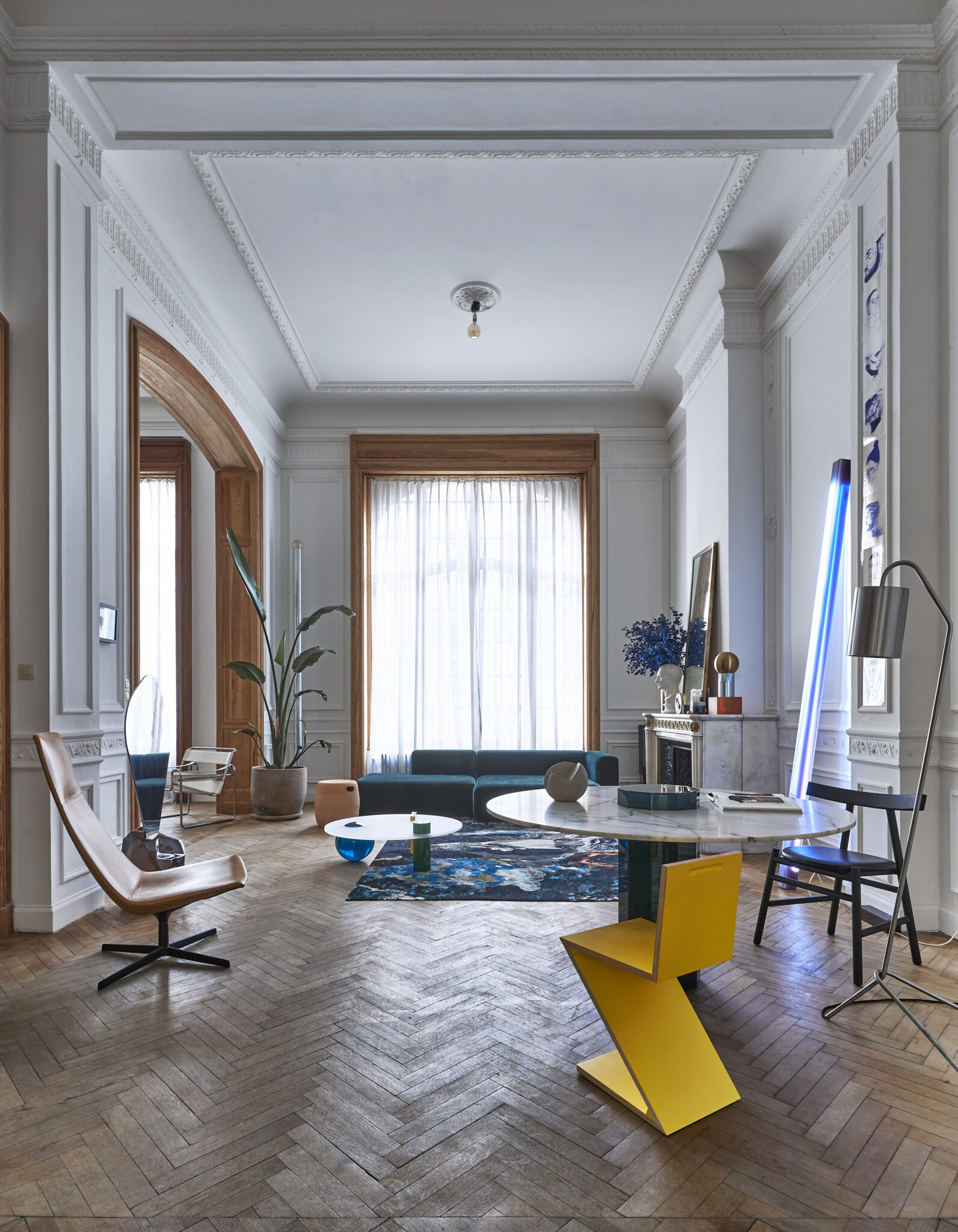
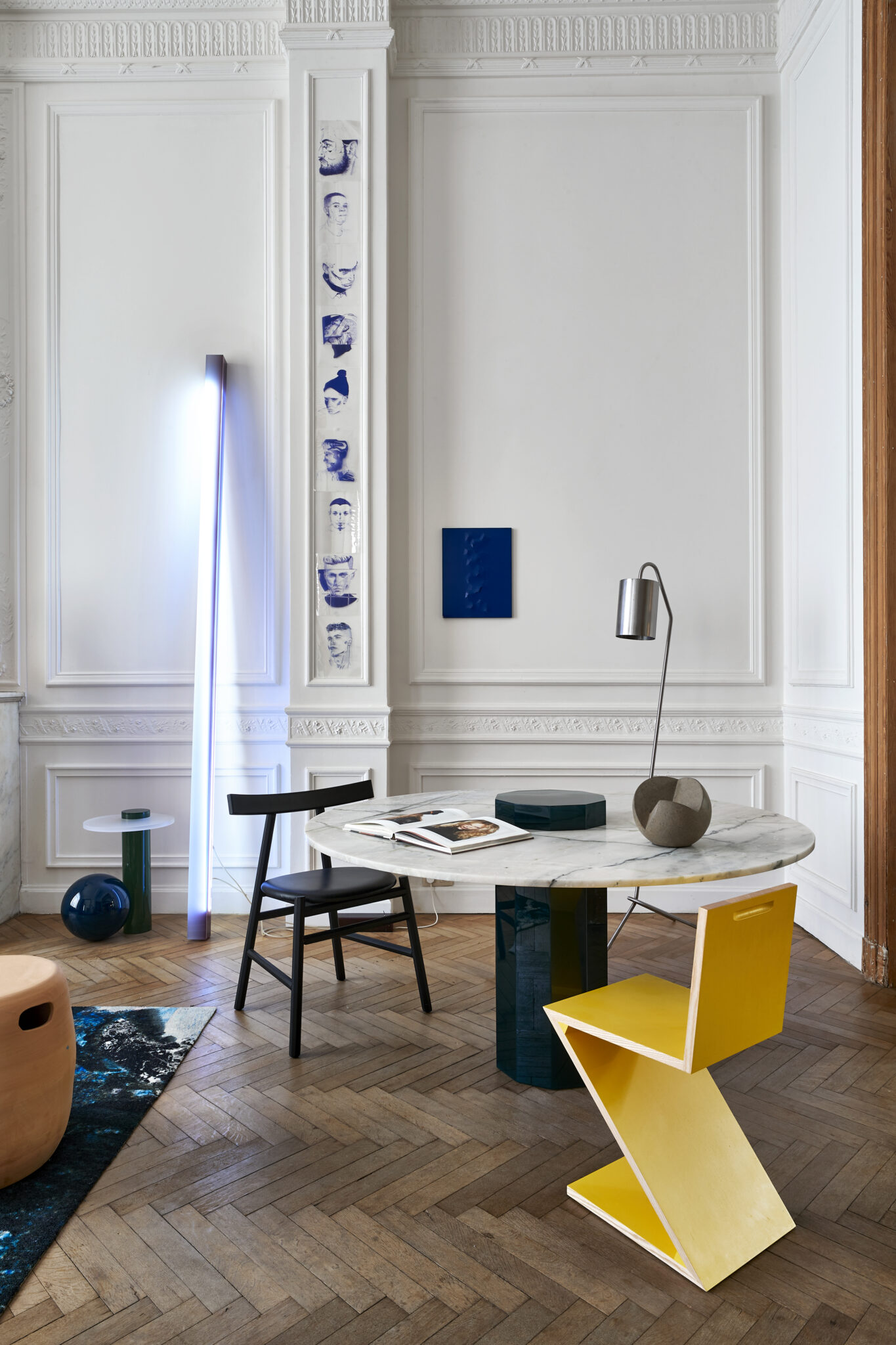
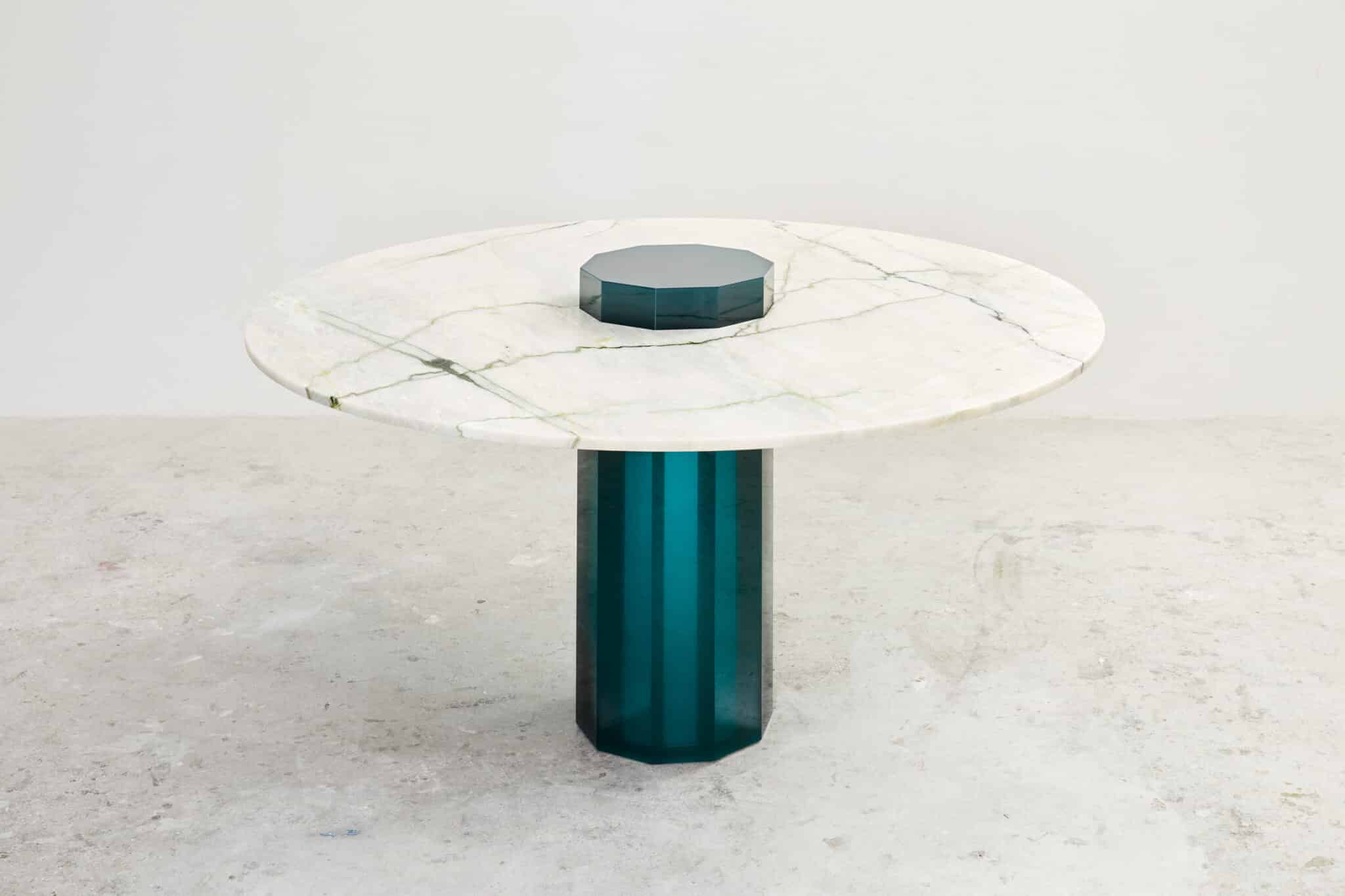
We never want to see how a piece is fixed, and we want to emphasize this by putting the focus on the supporting elements. The legs of our tables always pierce through the tabletops. It’s a specific language that we like, it organises the pieces itself, and it gives them more importance than the connecting piece (the tabletop). The fewer mechanical fixtures we have, the better. If pieces can connect or intertwine, it surely has our preference.
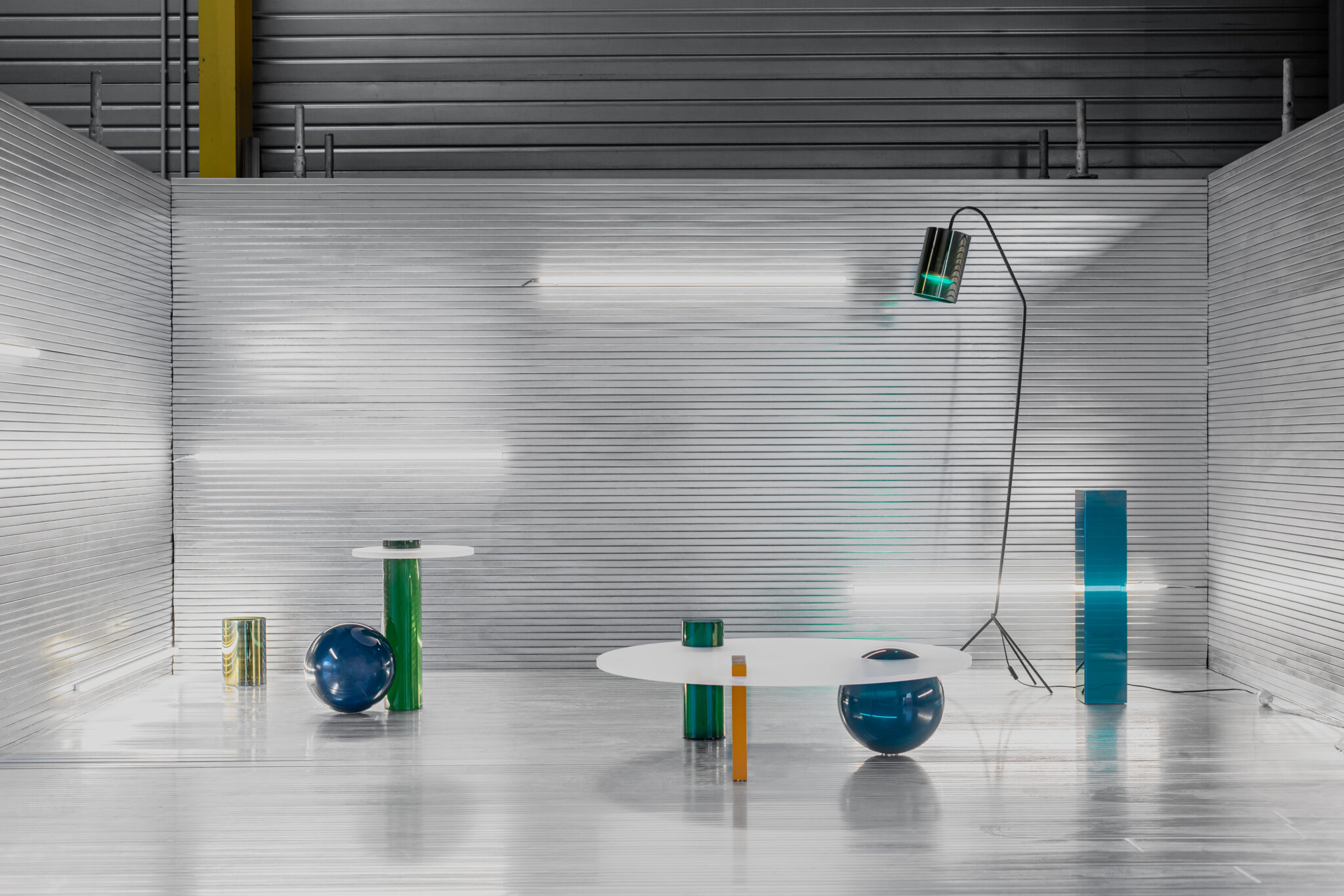
Design with a free mind, the furniture scene is quite generalised, and the key is to get out of that generalisation. A basic table has four legs, but that’s only because it’s structurally the easiest way. Everything that exists today in the furniture scene can be revisited, but it’s better to create with an open mind as much as possible.
Maybe an abstract classical art form. For example, our Pilastro table is based on ancient Roman columns, but made abstract, semi-transparent, and colourful.
Donald Judd for his minimalism and comfort. Charlotte Perriand for the elegance in her furniture.
Reisinger studio: let alone for the graphics they can bring forward.
Francesco Balzano: He has the ability to make objects of half a ton seem light as a feather.
Niko Koronis: Because he is a lot of fun!
Anish Kapoor / Matthew Barney / Pierre Soulages.
Our pieces are a certain form of light living, naïve but so much fun.
“We pick up elements from our daily life that we find, mostly unconventional, and try to rework those into a design element.”
The Questions
(The Proust Questionnaire is a set of questions answered by the French writer Marcel Proust.
Other historical figures who have answered confession albums are Oscar Wilde,
Karl Marx, Arthur Conan Doyle, Stéphane Mallarmé, Paul Cézanne…)
Kenny & Hugues: It’s an inner feeling of warmth and joy.
Kenny & Hugues: Losing the people we love.
Kenny: I like being right…
Hugues: I sometimes have a bad temper.
Kenny: People who always want to be right.
Hugues: Being a diva.
Kenny: My mother, of course.
Hugues: Yes, my mother.
Kenny: The wedding we are planning in Italy.
Hugues: Spending my money on jewellery / if I were rich, I would go crazy.
Kenny: A bit too peaceful, I’m not the biggest clubber, but I miss it.
Hugues: I am relaxed and feel very creative / as Kenny, I miss techno parties.
Kenny: Confidence, I like to see the fragile and sentimental parts of people.
Hugues: The religious faith / this has brought nothing but unhappiness and sadness.
Kenny & Hugues: This question is too ancient, we don’t like to think in gender. Either way, if you can make me laugh, we will go a long way!
Kenny & Hugues: See question above.
Kenny: “Hugues, how do you plan to execute this?”
Hugues: “Kenny, you are bugging me.”
Kenny: I would love to be able to sing. I would help Hugues a lot, too, when I put on music in the car.
Hugues: playing piano / it feels very sexy.
Kenny: “Think it, don’t say it.”
Hugues: Being more patient.
Kenny: I would say the first piece we created was “Cicero”.
Hugues: The creation of Cobra Studios with the man I love and our first article in Wallpaper magazine.
Kenny: Our dog Brigitte (Hungarian braque). To me, she has the best life.
Hugues: A disco ball.
Kenny: Umbria, Italy.
Hugues: In Greece.
Kenny: I don’t really have treasure; it’s not a possession, but I would say our dog.
Hugues: Objects from my family.
Kenny: Not feeling at home somewhere.
Hugues: Feeling lost.
Kenny: Going to look at prototypes and make the final adjustments.
Hugues: Making compositions with elements I have at home to create new objects and scenograph them.
Kenny: I would do anything for the people I love.
Hugues: Easily persuaded to go clubbing.
Kenny: Loyalty.
Hugues: They support me / I support them.
Kenny: Murakami.
Hugues: Arthur Rimbaut.
Kenny: Probably Peter from Family Guy.
Hugues: Arsène Lupin.
Kenny: No idea.
Hugues: Simone veil.
Kenny: My mom.
Hugues: No idea.
Kenny: Vivian.
Hugues: Auguste / Calisto.
Kenny: The smell of cooked salmon.
Hugues: Hypocrisy.
Kenny & Hugues: No regrets for now to be honest.
Kenny: A heart attack due to overexcitement.
Hugues: From a huge laugh.
Kenny: Why sleep?
Hugues: Nothing ventured, nothing gained.

“Our pieces are a certain form of light living, naïve but so much fun.”
SHARE :