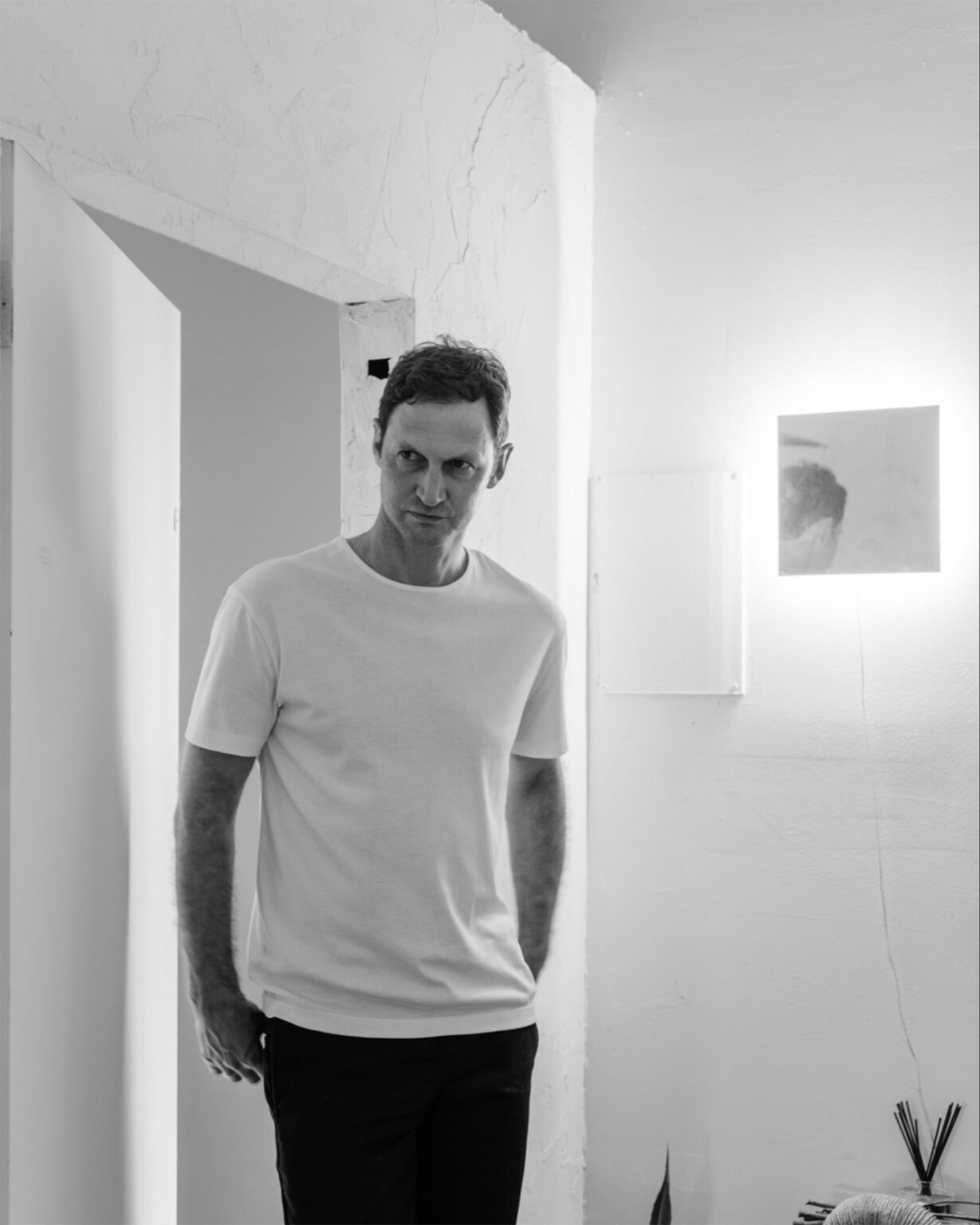

Arthur Bitsch
Arthur Bitsch is a French artist and designer based in Strasbourg. Trained in both design and visual arts, he develops a multidisciplinary practice spanning collectible design, sculpture, scenography and artistic direction. Through his studio, he creates works that challenge conventional typologies, exploring the intersection of function, symbolism and narrative. His approach considers objects as both functional pieces and carriers of meaning.
Rooted in research and experimentation, Bitsch’s work draws on mythology, ritual, architecture and cultural memory. He combines handcrafted processes with contemporary production techniques to create objects that move between the familiar and the unexpected. Characterised by strong sculptural forms and a conceptual approach to materials, his practice investigates how objects can hold stories, evoke emotions and connect with collective references.
Interview
I was born in Colmar, a town in eastern France not far from the German border, and grew up in a small village of five hundred inhabitants in the Alsatian mountains. My youth was shaped by the cycle of nature and the folklore of the region. After studying at the Beaux-Arts of Valenciennes and then Saint-Étienne, I worked in several cities; I finally settled in Strasbourg in 2021 to found my creative studio.
My first memories connected to art were no doubt nourished by the religious art of the churches of my native region. Born into a Catholic family, in which religion was still very present during my childhood, I would admire the works of these temples: the paintings, the sculptures, the bas-reliefs, and other relics. This no doubt fundamentally shaped my conception and my apprehension of art and of objects as vehicles of meaning and symbol.
I knew from the moment I entered the Beaux-Arts that art would be what dictated my life. It was there that I understood what art could be in its greatest diversity. I then worked continuously in this field, mainly in design, whether in an architecture practice or in industrial design. My own practice never ceased to evolve, often in parallel with my other activities. I had, however, decided quite early to devote myself entirely to my art and to stop working for other creators. In order to finance the making of my works, and no longer willing to work for another, I was confronted with manual labour on building sites and in factories. This developed a consciousness of work as effort and as personal construction through sacrifice.
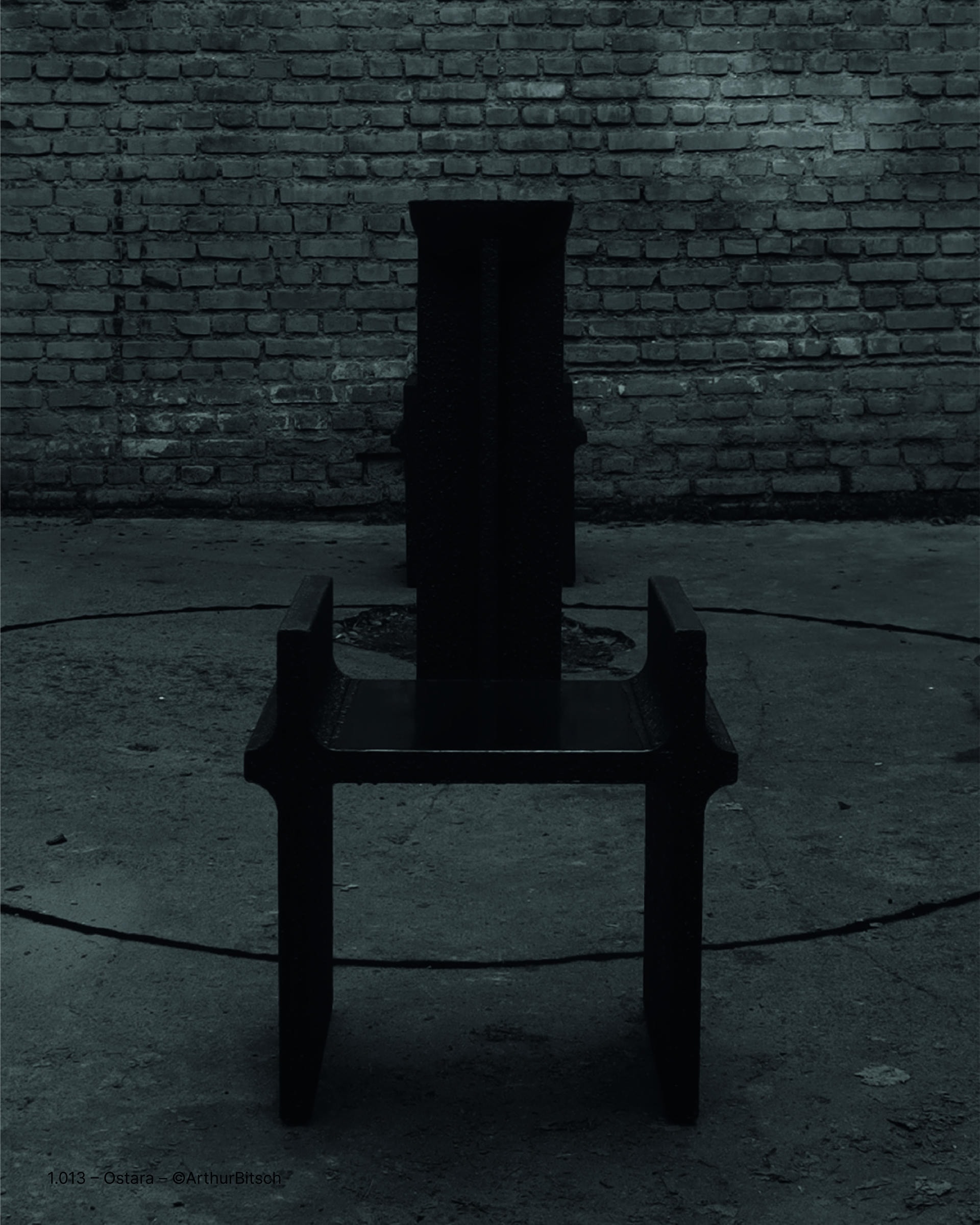
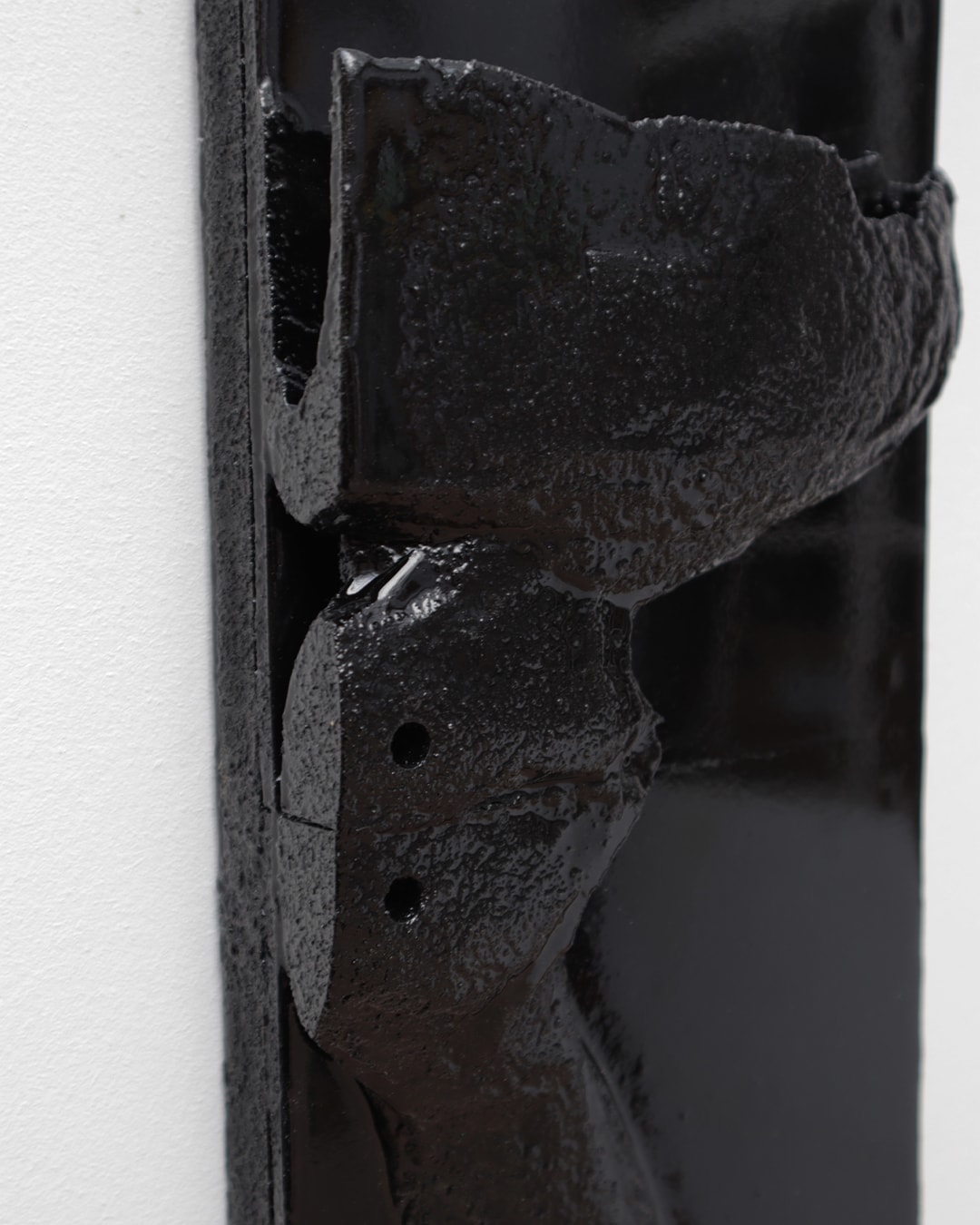
It was an almost initiatory path, beginning first of all with the necessity to create. At its core, design is for me a medium more than a profession. It is, however, one of those that seem to me most relevant and most connected to our era and our contemporaries. It also seems to me that I was able to see in this discipline something deeper than the mere fabrication and conception of objects. Deeper even than the mere usefulness of the object. It is this ambivalent, hybrid and eminently transversal character of design that drew me to this medium. I sensed that, behind objects, something more complex, more elevated, lay hidden.
My creative process is above all a self-driven and individual one. By incorporating a cyclical logic, my process of creation functions like a cosmogony: the creation of a universe. This cosmology shifts through time, made of growth, of acme, of decadence, of collapse. Works and ideas move within this great dynamic, within this great circle. Though it may seem occult, it is a global process of creation that I apply to my own life as well.
A typical day begins in my studio in the morning and lasts until the end of the day. The evening is often devoted to writing or reading. There is, however, no routine as such: I let my days be dictated by the necessity of creation, whether through fabrication, the conception of new concepts, or the writing of new ideas.
The choice I make of materials is dictated, on the one hand, by a will to research and experiment with matter itself. With each new collection or series, I tend to question materials or elements I have not yet confronted. Technically, my relationship to matter could be likened to an empirical, almost scientific process.
Nevertheless, I have learned and established a symbolic logic of materials. The materials used are certainly technical, but also vehicles of meaning. The pieces produced with these materials carry a formal symbolism, through their volumes, but also a material symbolism — a kind of operative alchemy.
What characterises my creations technically is, on the one hand, a certain almost industrial skill, allied with artisanal modes of fabrication. This certainly stems from my training as an industrial designer, but it seems to me above all the result of our era, in which my generation no longer concerns itself with academic technical compartmentalisation. The pieces produced have therefore often been created through the use of new technologies: 3D printing, digital and laser cutting, and so on.
These technological elements are not, however, sufficient in themselves: integrated into them is an artisanal technical capacity, as in my work with the material Dark Matter, which covers the pieces of the Nigredo collection. I would therefore define the technical particularities of my creations as a hybridisation of craftsmanship and new technologies. A hybridisation that is, at its core, the mirror of our societies.
The advice I would give to new artists is to never stop creating: the will to create must be lived as an ontological necessity, for it is what allows one’s development as an artist and as an individual.
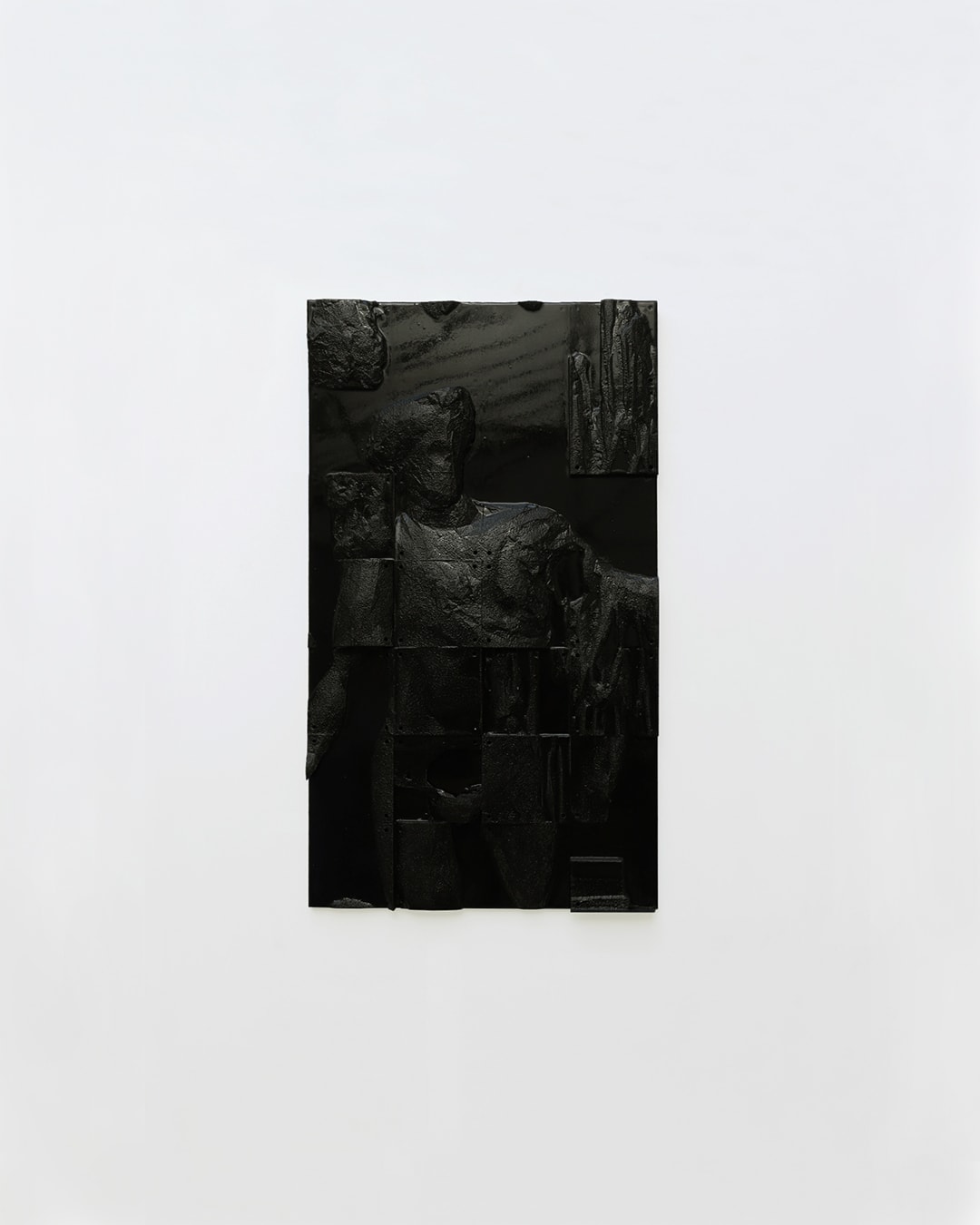
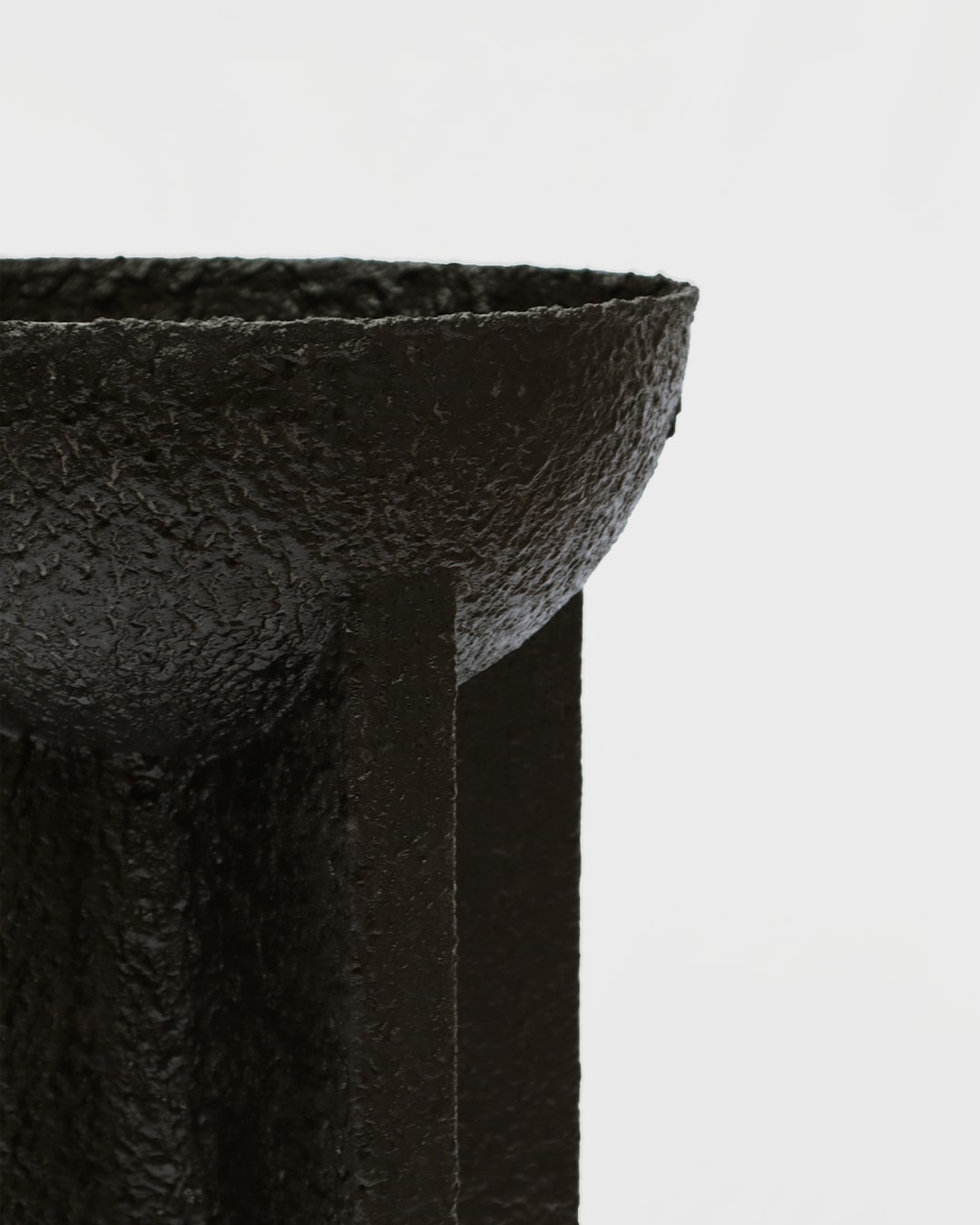
I situate my work within what I would call Surmodernism. This concept is one of a surpassing of modernity. Not, as one might read at first glance, through a boundless acceleration of technology, but as a true surpassing. This surpassing I see as possible through the use of modern tools, but for the purpose of metaphysical transcendence. Whereas postmodernism is only a cynical continuation of modernity, I propose with this concept a resacralisation of art through the technological forces of our era.
Jean Prouvé, for his utopia. Joe Colombo, for his legend as an individual. The Italian Radicals (Sottsass, etc.), for their overturning of the norms of design. William Morris, for his totalising vision.
Rick Owens, for the totality of his work and its occult aesthetic.
Batten and Kamp, for their innovation and their work at the frontier of art.
Pierre Soulages, for his definition of black as light. Anselm Kiefer, for my Rhenish filiation and his baroque understanding of art. Le Corbusier, for the totality of the work and the modernist overturning of values. Tadao Ando, for the sacrality of concrete.
Surmodern.
“I sensed that, behind objects, something more complex, more elevated, lay hidden.”
The Questions
(The Proust Questionnaire is a set of questions answered by the French writer Marcel Proust.
Other historical figures who have answered confession albums are Oscar Wilde,
Karl Marx, Arthur Conan Doyle, Stéphane Mallarmé, Paul Cézanne…)
Creation.
Remorse.
Laziness.
Gossip.
My brother.
Trance.
Productive.
Softness.
Vision.
Force.


Real.
Painting.
–
Life.
Me.
My workshop.
–
Poverty and hunger.
Reading.
Self-driven.
Sincerity.
Nietzsche.
Prometheus.
C.G. Jung.
–
Golem.
Vulgarity.
Not having tried.
Without regret.
Become who you are.
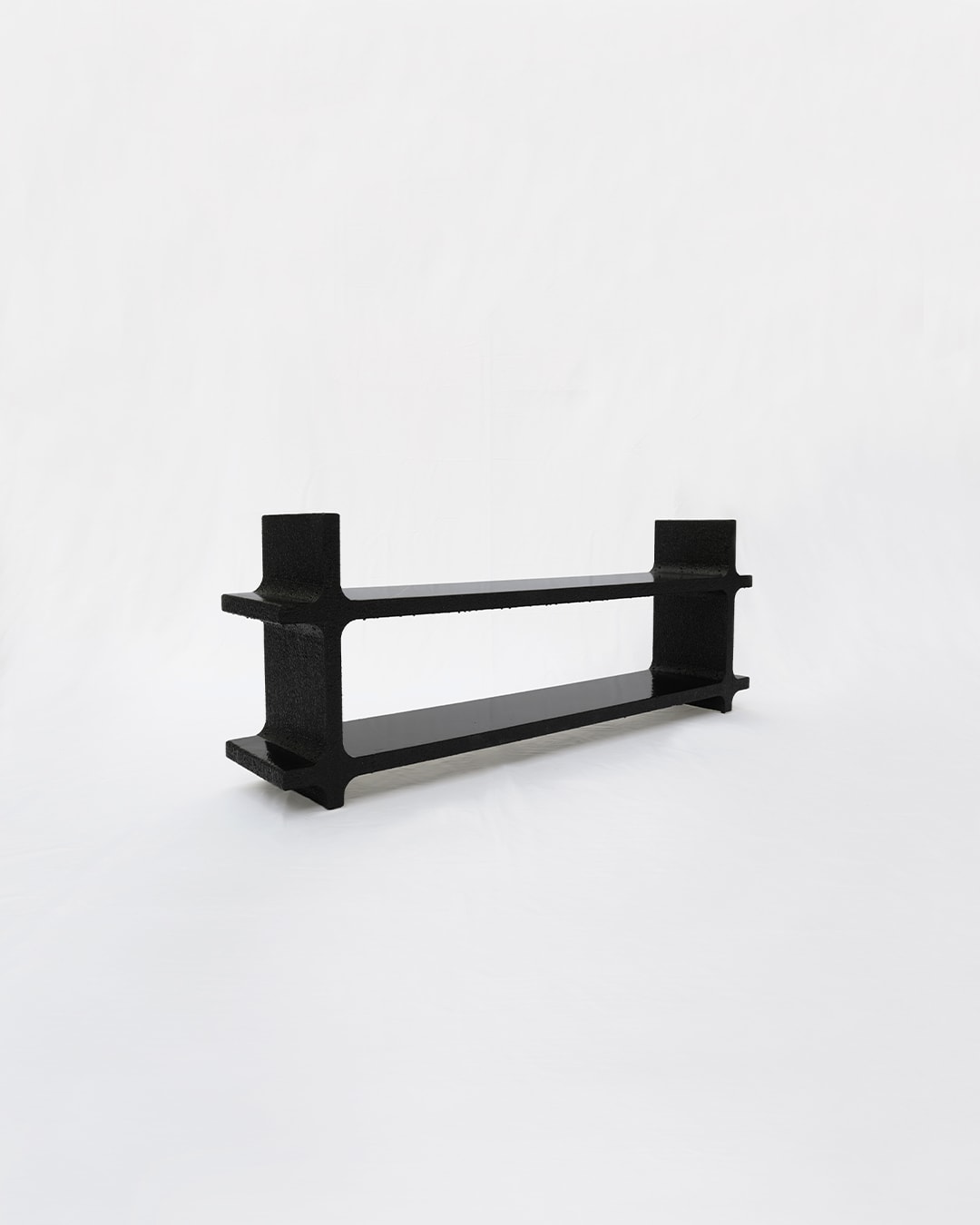
“The will to create must be lived as an ontological necessity.”
SHARE :