
A Light with No Name
By Johanna Enger
The light of the Nordic summer twilight has a rare and elusive quality. The sun has already set, perhaps a full hour ago. Yet the sky remains luminous, though no longer with the light of day. It shifts through muted shades that have no names. Buildings and trees gradually become silhouettes against the still-bright sky. Nature creates a moment in which the sky and the earth seem to belong to different times. The sky still carries the day, while the landscape has already begun to drift into night. With the sun lingering just below the horizon, an indirect, diffuse light softens the contours of buildings and vegetation. The atmosphere is filled with what in Swedish is called trollsk, a melancholy that feels almost otherworldly, yet quietly expectant. The prolonged twilight becomes a lingering passage into the brief Nordic night, as likely to carry the promise of something yet to come as to invite us to rest.
The experience of a cold, snow-covered winter day is entirely different. On days of high atmospheric pressure, when the low winter sun shines from a cloudless blue sky, the air feels crisp and almost weightless. The light is clear and crystalline, casting long blue shadows across the snow. Such dramatic seasonal shifts in Nordic light can make the same landscape feel like two different worlds. Light changes more than what we see. It changes the world as it appears to us.
We tend to associate such experiences with nature. Yet the same phenomena unfold every day in our homes, workplaces and public spaces. Electric light, too, shapes how spaces reveal themselves, how materials are perceived, and how we orient ourselves, feel and interact with one another.

© Johanna Enger
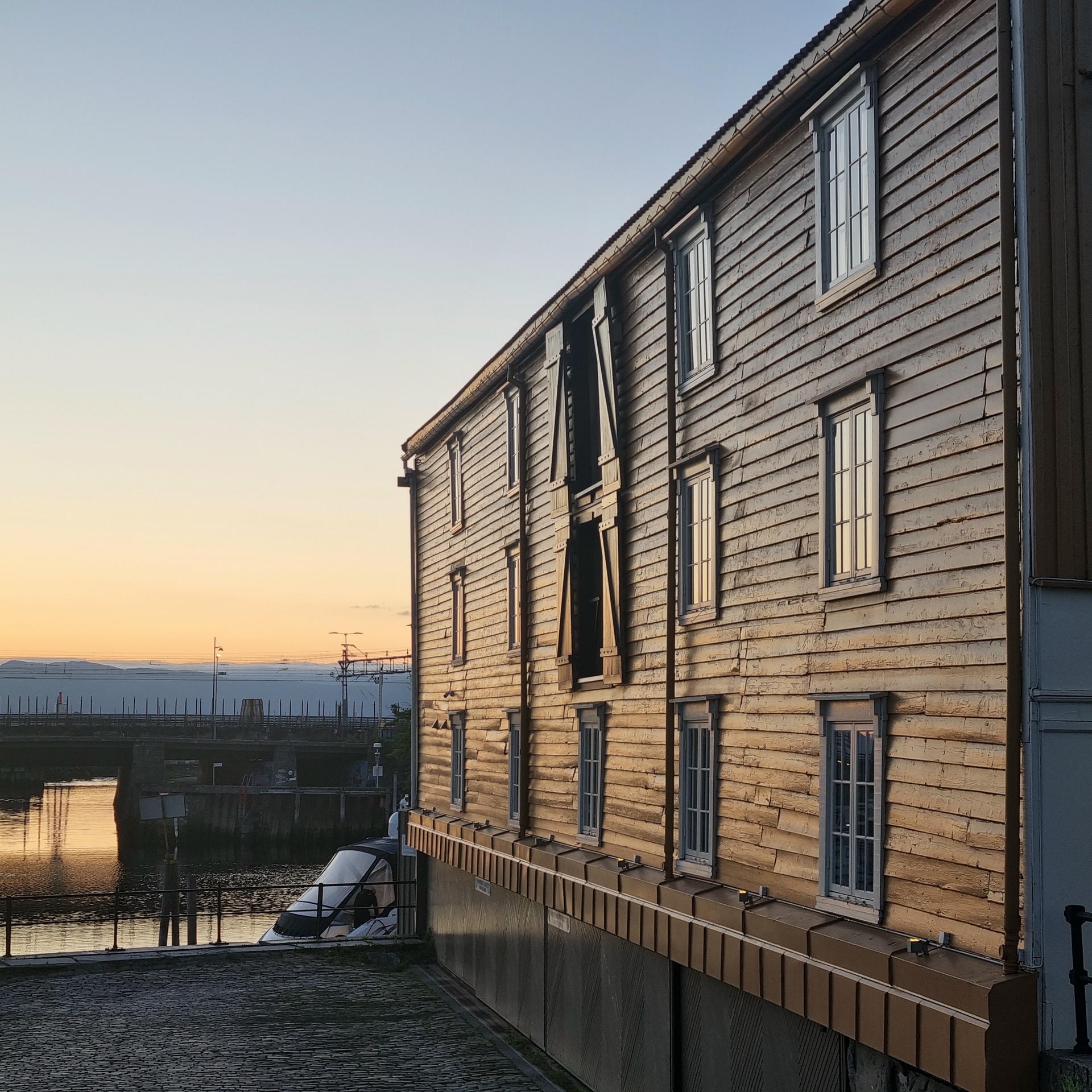
Nordic summer night. Trondheim, Norway, shortly before midnight in late May
Just over a century ago, our relationship with light changed fundamentally. On a farm or smallholding before electrification, the disappearance of daylight brought a kind of darkness that many of us today find difficult to imagine. The hearth provided warmth and some illumination, while tallow candles and oil lamps had to be used sparingly. Light after nightfall was a precious resource. Work left unfinished outdoors or in farm buildings had to wait until daylight returned the following morning.
Before electric light, there were several ways of illuminating the darkness, but they were limited and costly. Tallow candles were made from animal fat, while various animal and vegetable oils were burned in lamps depending on what was locally available. Beeswax candles burned more cleanly and brightly, but were expensive and used primarily in churches and affluent households.
The electrification of society, one of the great technological transformations in history, made it possible to produce light on a scale that had previously been unimaginable. Bill Bryson captures the difference between then and now: “Open your refrigerator door, and you summon forth more light than the total amount enjoyed by most households in the 18th century. The world at night, for much of history, was a very dark place indeed.” For the first time, the length of the human day was no longer determined by the sun. The working day no longer had to end at dusk, and factories, offices and public spaces could remain active long into the night. Electric light became one of the fundamental conditions of modern society. As electrification spread rapidly during the first decades of the twentieth century, it also brought a kind of democratisation of light. Abundant and reliable illumination was no longer a privilege reserved for those who could afford large quantities of fuel, oil or candles. With the simple flick of a switch, growing numbers of people gained access to something that, for most of human history, had been constrained by the sun, the seasons and economic means.
But, as with almost every profound transformation of society, the new did not simply add something. Something was also lost. Once darkness could be overcome at the flick of a switch, it changed not only what we could do after sunset, but also our relationship with the natural rhythms of day and night and the seasons. Light went from being something we largely lived by and used sparingly to something we could produce, control and eventually take for granted. How deeply the changing rhythms of light were once embedded in our understanding of the world is reflected in mythology.
In Norse mythology, the sun is personified by Sól, or Sunna, while her brother Máni personifies the moon. According to Snorri Sturluson, they were the children of Mundilfari, who named them after the sun and the moon. Angered by this, the gods placed the siblings in the heavens, where Sól was made to drive the sun across the sky and Máni to govern the course and phases of the moon. Sól is pursued across the heavens by the wolf Sköll, who will finally catch her at Ragnarök.
A lesser-known detail of the story is equally evocative. Sól’s husband is named Glenr, a name that has been interpreted as “an opening in the clouds”. We know almost nothing about him, but the name itself is suggestive. In a Nordic climate, where the sun is often concealed by cloud and may suddenly break through an opening in the cloud cover, this is an immediately recognisable experience of light. The changing light was more than a change in visual conditions. It was part of how time, nature and the world were experienced and given meaning.
Gods representing the sun, its life-giving power and its rhythms can be found in many ancient cultures: Amaterasu in Japan, Ra in ancient Egypt and Inti in the Inca Empire are just a few examples. They bear witness not only to the sun’s obvious importance as a prerequisite for life, but also to light as a fundamental part of human lived experience.
Learning to See with Light
As a species, humans have evolved in interaction with the dynamics and variations of natural light. This is not only about the shifts between daylight and darkness over the course of the day and the year, but also about how we perceptually read and understand our surroundings through light. Differences between highlights and shadows, between lighter and darker areas, and between absorbing and reflecting surfaces help us distinguish form, material, depth and spatial relationships. Light therefore does more than make our surroundings visible; its variations help structure the way space appears to us.
With electrification, we gained control over light and could free ourselves from the natural cycles of day, night and season. Electric light came primarily to serve practical and functional needs, closely associated with work, production and learning. Good visibility was central: sufficiently high light levels, uniform illumination and the absence of disturbing shadows made visual tasks easier and safer to perform. This had a clear basis in visual ergonomics: lighting should provide good conditions for visual work and contribute to safe and functional working environments. To quantify and specify the light, the photometric system that had been established some 150 years earlier was used. On the task area itself, these qualities are often both relevant and necessary. But when the same principles come to define the lighting of the entire space, the result is often static and uniformly distributed light, with reduced differences between highlights and shadows.
In parallel, a practice-based body of knowledge developed around the spatial and experiential effects of light. Lighting designers, interior architects and architects use light to shape space, reveal materials and create spatial hierarchies through variations of light and shadow, thereby also contributing to the atmosphere of a space. William Lam, Juhani Pallasmaa and Peter Zumthor are well-known examples, but the same approach can be found among many practitioners. Lam described light as a “formgiver” for architecture. Some lighting designers describe themselves as craftspeople: every project is unique, and light is treated as a material through which space takes form. A closely related understanding can be found in perceptual psychology. Sensory experience is relative and contextual: we do not perceive individual stimuli in isolation, but in relation to their surroundings. A surface, for example, may appear lighter or darker depending on the lightness of the surfaces around it. Contrast is therefore not simply a measurable difference between light and dark, but a perceptual relationship. Its character also matters: the transition between light and dark may be sharp, diffuse or gradual, producing very different spatial impressions. Contrast is fundamental both to how we see and to how light gives form to space.
Between these two perspectives on knowledge, light understood as a measurable physical stimulus and light understood as spatial experience, there is a discrepancy with consequences for both practice and research. There is still no established framework for relating perceived lighting quality to the measurable properties of light.
When Light Became Measurable
Humans have been trying to understand light and vision for thousands of years. Plato imagined an inner fire within the eye that flowed out through the gaze and, in daylight, joined with the kindred fire outside us. Together they formed a bond between the observer and the observed, through which impressions could reach the eye and the soul. The idea of vision as something arising in an encounter between the human being, light and the world still has a certain resonance today.
A decisive step towards modern optics was taken by the Arab scientist Ibn al-Haytham around the year 1000. He demonstrated that vision requires light to reach the eye from outside, either directly from a light source or after being reflected from an object. This also opened the way for light to be studied as a physical phenomenon, distinct from the experience of seeing itself. Over the following centuries, knowledge developed of how light propagates, reflects and diminishes with distance. In the eighteenth century, Johann Heinrich Lambert systematised this emerging knowledge in his Photometria of 1760 — literally, the measurement of light. With Photometria, Lambert laid the foundations of photometry as a scientific discipline and of the systematic measurement and comparison of light. For most people, this scientific achievement initially had little practical significance. Homes were still illuminated by tallow candles, oil lamps and other locally available light sources, and there was little everyday need to specify their performance with any precision. But roughly a century and a half later, the situation had changed radically. Light could be mass-produced using different technologies, new light sources and luminaires were being developed, and an international market was emerging. Suddenly there were both economic and practical reasons to measure and compare how much light different products produced and how efficiently they converted energy into visible light.
Powerful electric lighting also raised new questions about visibility, glare, shadows and the levels of light required for work and other visual tasks. These developments created a need for common measures, recommendations and, eventually, standards. The International Commission on Illumination, CIE, was established in 1913 from the earlier International Commission on Photometry, and during the first decades of the twentieth century, the photometric systems that still underpin how electric lighting is measured and specified were established. Since then, through extensive and tireless international efforts, CIE has continued to develop the scientific foundations for the measurement, comparability and standardisation of light and lighting.

Composite image: Adobe Stock image and graphic elements by Johanna Enger
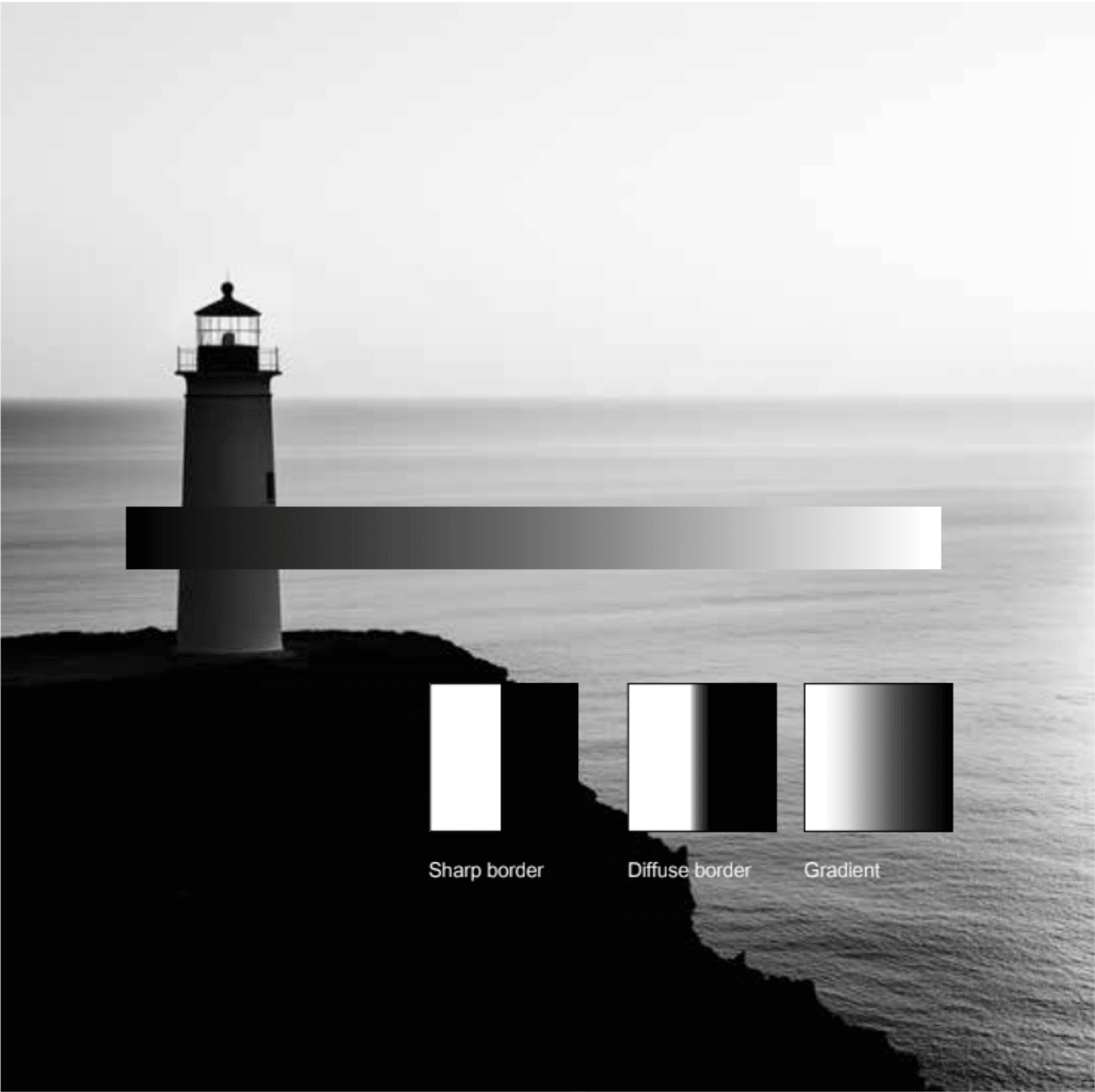
Contrast is relational. We do not perceive light and dark in isolation, but in relation to what surrounds them. Contrast, and whether its boundaries are sharp, diffuse or gradual, helps light reveal form, depth and space.
Measuring the Senses
The food and beverage industries faced some of the same problems as the lighting industry as production became industrialised. Previously, a local producer of cheese or wine, for example, could rely on an experienced master craftsperson who used their senses and professional expertise to assess quality before the products were sold. With mass production, such a system became too vulnerable and dependent on individual judgement. Products were also being sold in larger markets, sometimes exported, and needed to be compared and positioned against competitors. Reproducible methods for quality assurance and product development were needed. But there was a crucial difference from the lighting industry. In food and beverages, sensory experience taste, smell, texture and appearance, was a central part of the quality of the product itself. Measuring its physical and chemical properties was therefore not enough. It was also necessary to investigate and systematise the human sensory response. Out of this need grew sensory analysis, in which the human senses are used as measuring instruments under controlled conditions. Trained panels assess defined attributes according to standardised protocols and scales. One such attribute might, for example, be the fruitiness of a wine. In this way, a complex sensory experience can be broken down into qualities that can be described, compared and, to some extent, quantified.
These methods can be used for quality control and product development, as well as to investigate how products are perceived and preferred by different groups of consumers. Sensory analysis is now an established discipline encompassing a wide range of methods, and is used in both research and commercial product development across many fields. Anyone who has taken part in a wine or chocolate tasting has encountered a much freer and more informal relative of these methods.
There is a clear distinction between sensory analysis and photometry, even though both systems seek to express properties in precise numerical terms. Photometry quantifies properties of the physical stimulus—light radiation—even though its measures are weighted according to the sensitivity of the human visual system. Sensory analysis, by contrast, makes it possible to systematically describe and quantify aspects of sensory experience. Its variables are therefore expressed not as physical quantities, but as verbally defined perceptual attributes.
If sensory analysis uses the human senses as a form of measuring instrument, language becomes central to the method itself. Clearly defined terminologies are developed for different product domains, in which an attribute, such as fruitiness, bitterness or crispness, denotes the quality to be assessed and rated on a scale. This has both advantages and limitations. The great benefit is that aspects of a complex sensory experience can be translated into something that can be described, compared and handled analytically. Terminology can also help us distinguish and become aware of aspects of an experience that we previously lacked the words to describe. At a wine, beer or chocolate tasting, an experienced guide can direct our attention towards dimensions of taste and aroma that we had previously been unable to distinguish. But this same quality also contains the method’s limitation. A given terminology helps us distinguish certain dimensions of experience, while at the same time directing our attention towards what has already been defined. Language opens up experience, but it can also delimit it. What makes sensory analysis particularly interesting, however, is that it builds a bridge between different ways of creating knowledge about the world: between the sensory and the analytical, between lived experience and the attempt to describe it systematically.
What Counts as Knowledge?
Distrust of the senses as a source of knowledge has deep roots in Western intellectual history. Rudolf Arnheim describes how, as early as around 500 BCE, Parmenides went so far as to claim that the world was fundamentally unchanging, despite our senses constantly telling us otherwise. When reason and sensory experience presented conflicting accounts of reality, it was the senses that had to give way: reason was to correct perception and establish what was true. Throughout history, it has been easy to find examples that seem to confirm the unreliability of the senses: a stick immersed in water appears bent, and a distant object appears smaller. But the fact that perception is context-dependent does not mean that it is arbitrary or lacks a logic of its own. In perceptual psychology, two surfaces with the same measured luminance can, for example, appear differently light depending on their surroundings. This perceived difference cannot be determined by measuring the light alone, because it arises perceptually through the relationships between different parts of the visual field. What we experience, then, is not an imperfect physical measurement of the world, but the result of how our perceptual system organises and interprets the information that reaches us.
Physical measurements, perceptual assessments, models and theories provide us with different tools for investigating and analysing the world. But none of these analyses is the world itself. Lived, sensory experience is the reality we inhabit; measurement and analysis are our attempts to understand, describe and systematise aspects of it. Yet knowledge that can be measured, quantified and verified has acquired a powerful interpretive privilege in Western culture, as though what can be described most precisely must also be what best describes reality. This ideal of knowledge also aligns remarkably well with the needs of the modern society we have built, in which comparability, reproducibility and explicit criteria are fundamental to the organisation and governance of complex systems.
From this perspective, standards can be seen as a practical extension of an empirical-scientific approach. To function, they must minimise ambiguity and room for interpretation: a requirement must be measurable and verifiable, and it must be possible to determine whether or not it has been met. In many contexts, this is also a necessity. When safety, health or the ability to perform a task is at stake, room for interpretation can entail real risks. This becomes particularly evident in modern production processes. In both product development and the building process, decisions have to be made, responsibilities allocated and different stages approved before the process can move forward. A clear threshold, a measurable performance criterion, or a simple yes or no is easy to communicate, verify and specify in procurement. What can be expressed as a number therefore acquires a particular practical power, not necessarily because it is more important than what is harder to measure, but because it is easier for the system to handle.
It is in the building process that these different perspectives meet “on the ground”, in practical reality. The designer or architect has to balance the client’s intentions for what an environment should express with the users’ needs for visual ergonomics, functionality and an appealing atmosphere. At the same time, they bring their own professional experience, intuition and design vision of how the space should be experienced and what will work. All of this must be negotiated alongside measured values, standards and regulations that serve important purposes, but can sometimes constrain the realisation of the intended design. The lighting designer stands particularly clearly at the intersection of these worlds. Light is at once a physical quantity that can be calculated and verified, a technical system to be designed and installed, and a formgiver in architecture. Its effects ultimately arise in the encounter between space and the human being.
Building a Bridge
LENS (Light Experience & Nomenclature Structure) was developed as an attempt to build a bridge between these perspectives. Inspired by sensory analysis, the method uses verbally defined attributes and scales to describe and systematise aspects of perceived light quality and relate them to the measurable properties of light. It has been developed step by step through studies using scale models and full-scale environments. At Uppsala University’s Ekonomikum building, and later in two seminar rooms at Konstfack – University of Arts, Crafts and Design, participants assessed qualities such as perceived light level, contrast and light distribution, alongside more qualitative descriptions of the light and the space. The method provides a measure of the spatial experience of a light environment, which can then be compared with assessments of other environments and related to physical measurements, psychological studies, or the designer’s visions and intentions.

Table and images © Johanna Enger
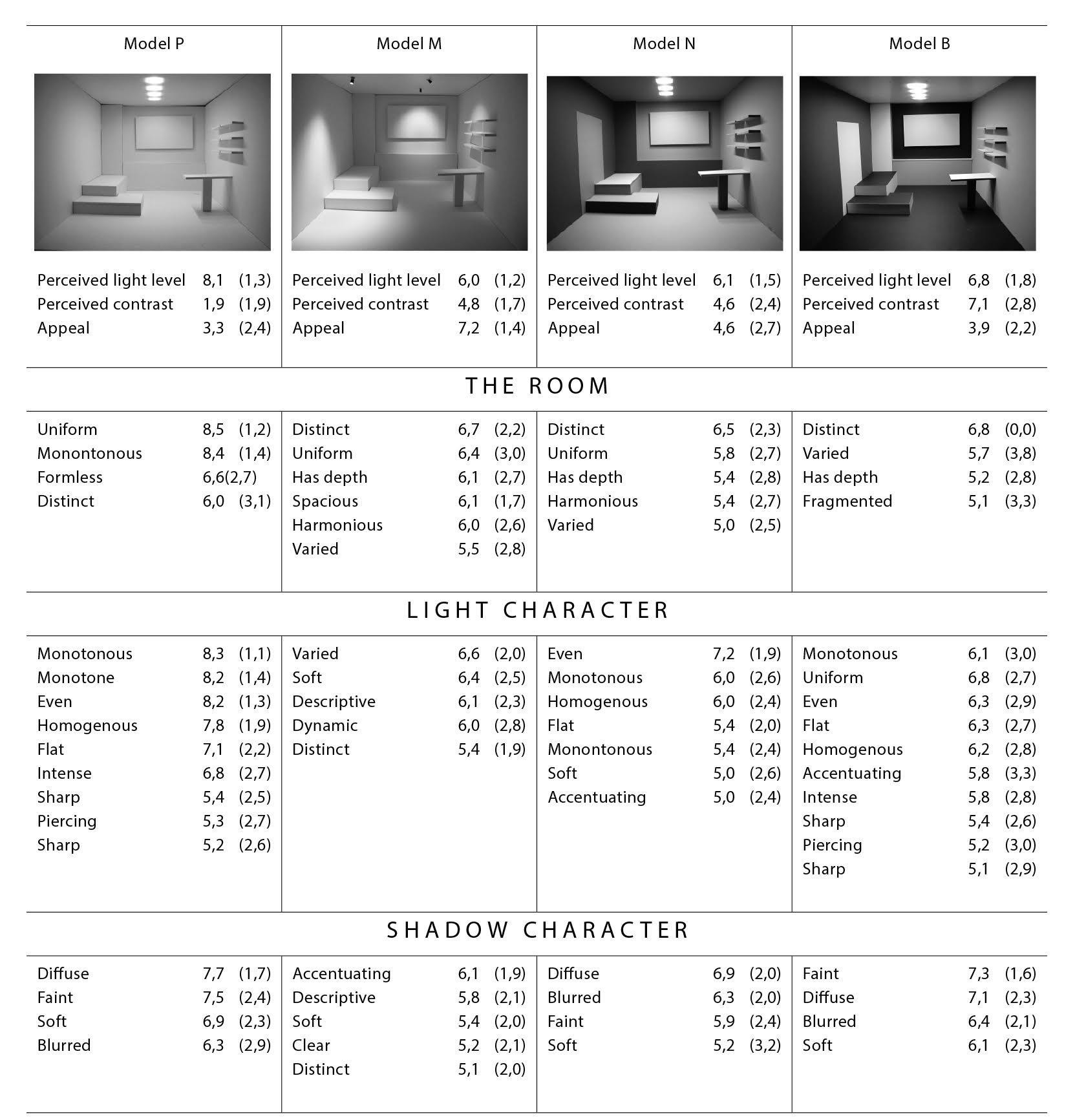
The LENS Method. The same room takes on different spatial qualities as the distribution and contrast of light change. The numbers show participants’ mean ratings on a ten-point scale for perceived light level, perceived contrast and appeal, with standard deviations in parentheses. The words below show the qualities most strongly associated with the room, the light and the shadows; the terminology was developed in Swedish and has been translated here into English.
LENS has also been explored as the basis for a digital tool that could help designers and architects communicate and discuss design choices at a more fundamental level with clients and other stakeholders. Target-group and needs analyses were conducted as part of the project, and interviews with lighting designers and other actors in the building process revealed how difficult it can be to communicate the experiential qualities of light. Lighting calculations provide precise values, while design intentions are often conveyed through conversations, reference images, renderings and professional experience. A lighting designer hardly needs a tool to tell them how to shape a space. What may be needed, however, is a shared frame of reference through which that knowledge can be communicated to a client, architect or electrical consultant, and kept alive throughout a lengthy building process.
The prototypes therefore combined perceptual and atmospheric concepts with reference images and research-based assessments. The intention was to provide a basis for discussion and a shared frame of reference, using a common terminology for the perceived qualities of light to clarify and communicate design intentions. A client’s wish for, say, “a cosy atmosphere, but with good working light” could thus develop into a more nuanced conversation about what this actually means in terms of the character and distribution of light, contrasts and perceived light level. By combining a shared terminology with visual references, different actors can clarify what they mean and discuss how a design intention might translate into spatial qualities of light. LENS can therefore be used to assess and compare existing environments in research, while also having the potential to serve as a shared language between the measurable, the professionally designed and the experienced light environment throughout the design and building process.
LENS is one of several possible ways of approaching the spatial experience of light. Photometric measurements can describe the physical properties of light; perceptual assessments can reveal how we perceive them; and language can help us distinguish and share qualities that might otherwise be difficult to communicate. Together, these different perspectives give us increasingly rich maps of a complex territory. Atmosphere arises through the interplay of light, colour, materials and space, but also through the body, memories, expectations and cultural background. The more ways we have of investigating it, the more we can understand, as long as we do not mistake the map for reality.
We need to continue searching for new ways to measure, describe and speak about light. But the experience itself eludes our measurements and categories. Where analysis can help us understand experience, art can give it form and allow us to experience something of it. A Nordic summer night, or a room whose light touches us without our quite knowing why, will remain a light with no name.
SHARE :