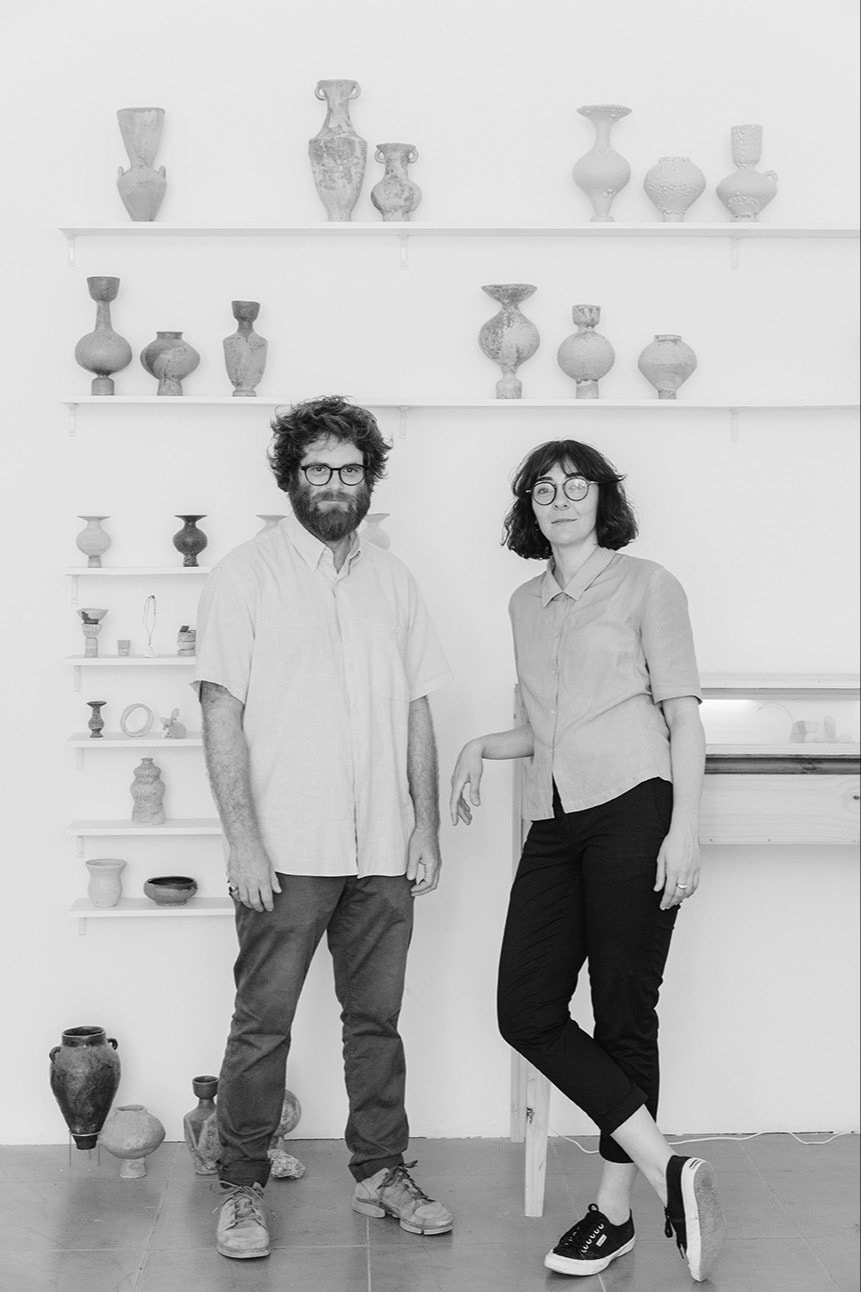
We come from two different places in Spain, Galicia and Almería. It could be said that, in order to meet, we’ve had to cover one of the longest diagonals of our country.
MAGAZINE · INTERVIEW
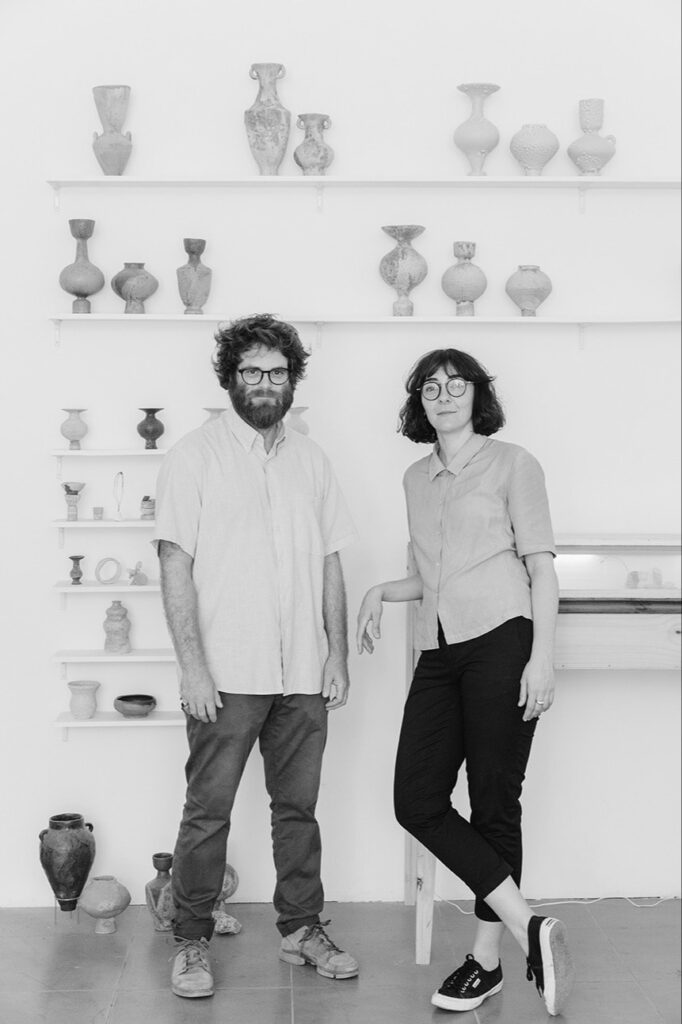
Raquel Vidal and Pedro Paz
Let's know more about
Interview
Where were you born and where are you from?
What is your first memory connected to the art world?
Pedro: I moved to Madrid in my 20s. My former flatmate was studying for a degree in Film Making, and it was during those years that I visited the Prado Museum, the Reina Sofía National Museum, and some other art galleries around the city for the first time. My interest in art kept growing, so I made the decision to return to school to be able to research artistic processes more deeply. I studied for a Degree in Fine Arts in Granada and later completed a Master’s Degree in Artistic Production in Valencia, the place where I live and develop my work together with Raquel and our newly arrived André.
Raquel: I was born into a quite artistic family. My father has always composed and played music with almost anything he could find, and my mother, apart from taking care of us, used to devote her free time to the theatre. My grandmother on my father’s side was a craftswoman; she made dolls, painted in oils, and I would walk downstairs to her workroom under the excuse of looking for the cats, when actually what I wanted was to look, smell, and touch everything there. Being there, in silence, was my fetish shelter. Afterwards, I studied at the Almería School of Arts, got my diploma in Granada, and came to Valencia to study the same Master’s Degree as Pedro. So here we are, producing everything we portray.
Have you always worked in the art/design field?
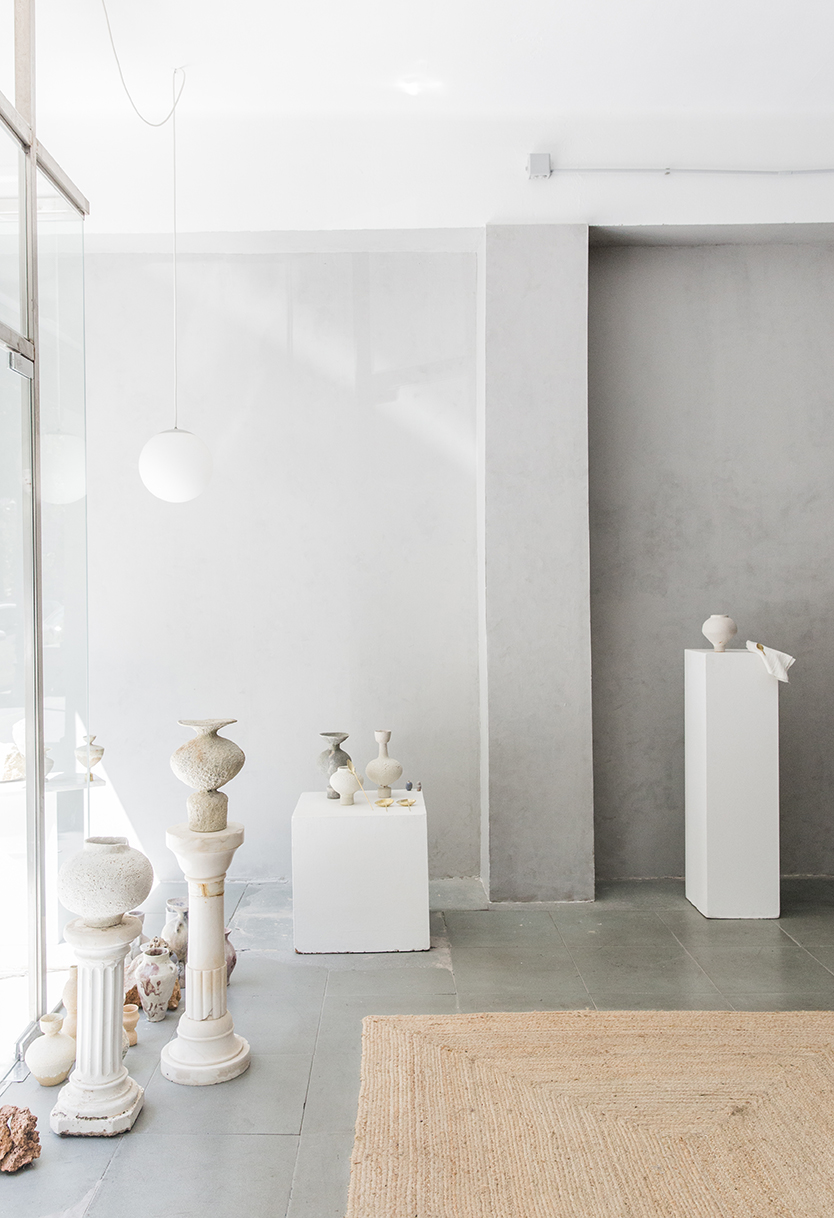
Since we met, we’ve worked together in many projects, which let us do continuous research in different but convergent directions derived from painting and sculpting fields, always wondering about the irrefutable space-time relationship. After several years of work in which we combined our most plastic production with image projects linked to photography, video, graphic and art direction, we came across metal and clay, two materials which, being strongly connected, caught our attention in terms of durability and because they have undoubtedly marked the development of our society.

What led you to design creation?
We realised metal and clay objects have always been needed, to carry food, to serve it, to preserve essence, to signal states or differentiate houses. It could be said that this is the moment when the idea of linking our plastic abilities to object design arises, inevitably connected to everything we had done before. We suddenly discovered that this new line of research was the means that would allow us relate our interests and that our workshop could be the physical place to work, experiment and share time, experiences and projects at a slower pace and in greater depth than the speed of the outside world demands. We needed our work to move away from the installative actions to become a project in which human relationships were established differently.
We felt the need to build a place where the dialogue with the people who approach it would be more physical and relational.
What are the technical particularities of your creations?
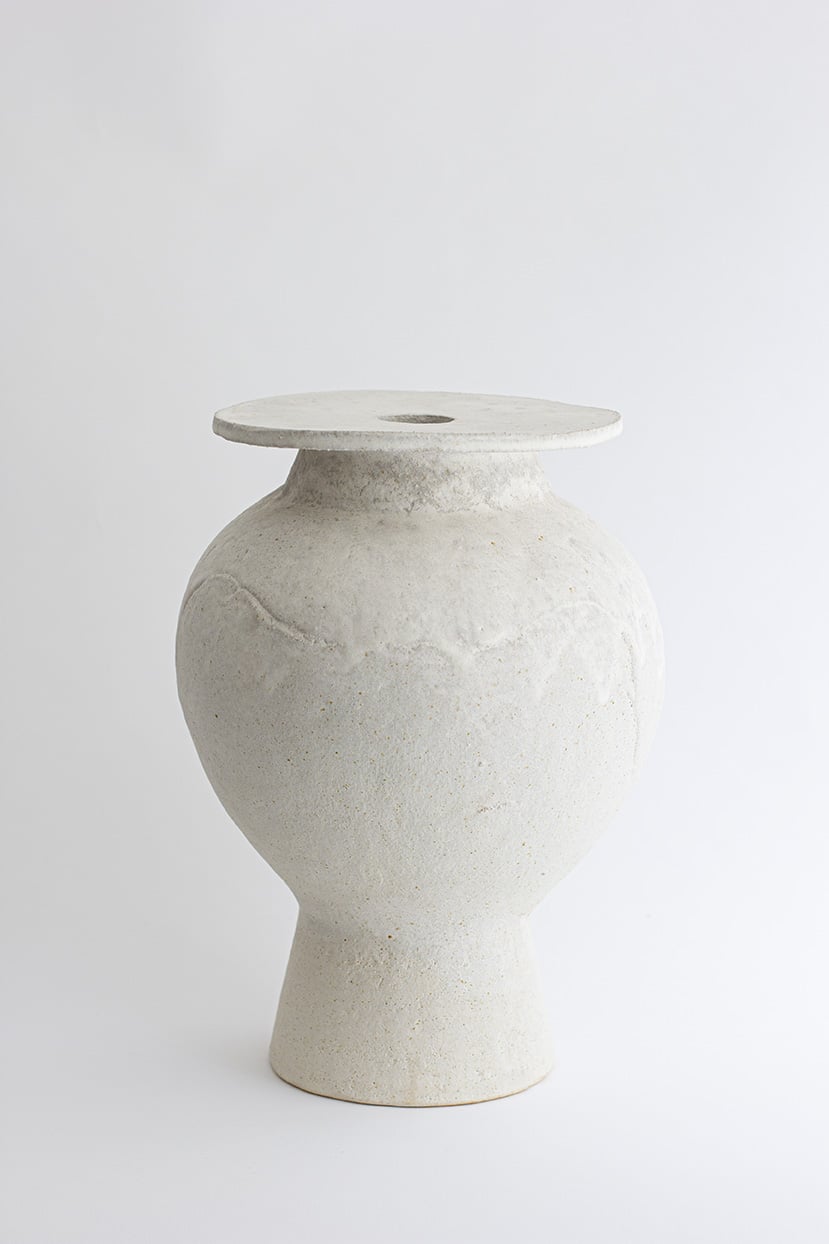
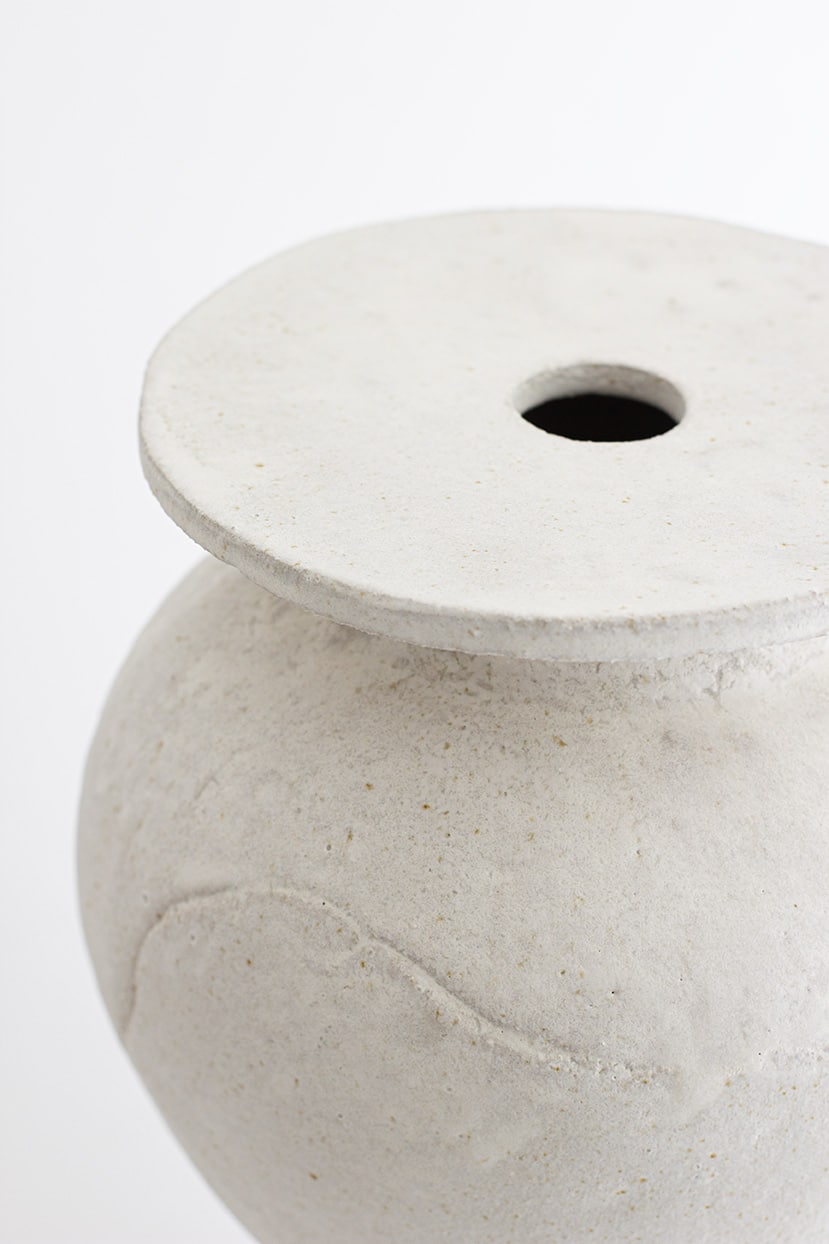
Our creative process is not subject to a previous single and concrete idea that may develop later, rather it is a becoming, a continuum in which one thing leads to another. We try to think and reflect on processes without a concrete opening and closure, one idea accompanies us to meet another. We draw and observe objects all the time, archive images that throughout the process are present, make sketches and small experiments that serve us to think and rethly about the shapes, textures, structures and images that we could do once the pieces are finished. But all this happens parallel to the construction of our objects, without a clearly differentiated before or after, we could say that we build thinking and think about building.
How would you describe your creative process and its influences?
The processes we enjoy the most and the way we like to approach them resembles the idea of a map, with a rheizomatic structure that allows a repositioning of images, words and objects to establish new relationships and create personal cartography open to constant rereadings.
Could you describe a typical day of your work?
Since André was born, our days have changed a lot and our organization is quite organic and full of unpredictable leads, as it is him the one who conducts the working times. Either way, we try to keep days relatively intensive in the morning. Pedro has breakfast at 6.30 so that he can start working in the workshop from 07:30 until Raquel and André arrive, which is usually at 10:30. From this time Raquel takes over the workshop until 13:30 or so. After lunch, we return to the workshop for a couple more hours, also alternating the work shifts to be able to play with André. At 18:00 our day ends, and we come back home for dinner and share a few hours together just the three of us. But this structure is only mental and serves us not to disperse too much, the reality is that the schedules are very flexible to be able to reconcile our working life with our family life, which is one of the most valuable things our profession has given us.
Why did you choose the specific materials you work with?
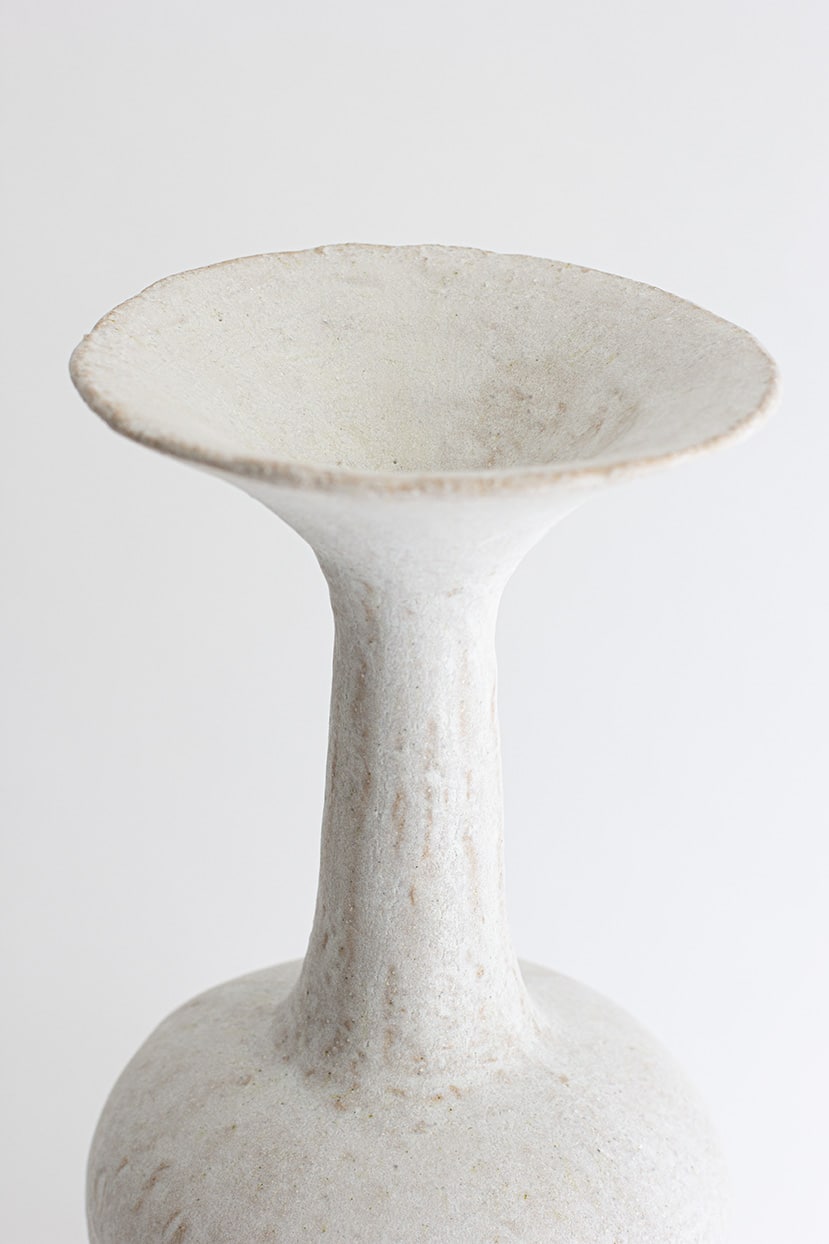
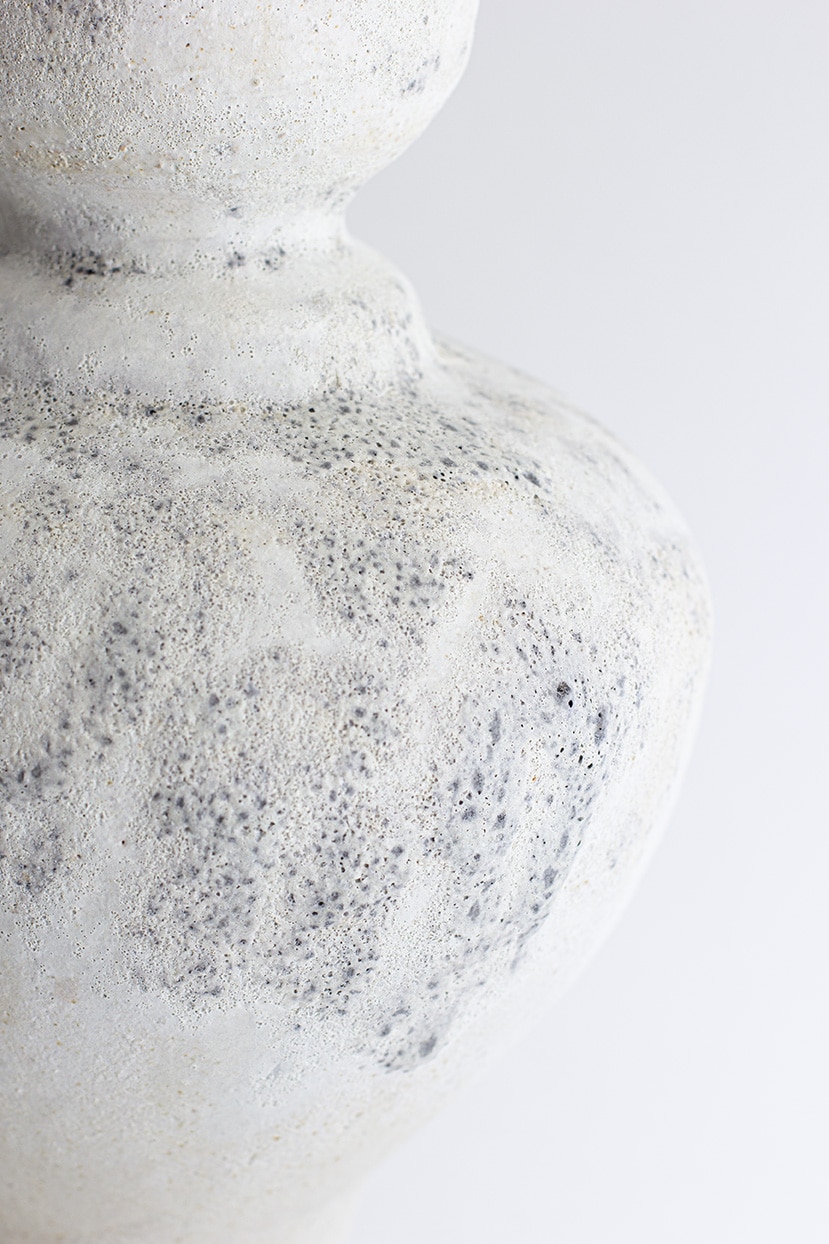
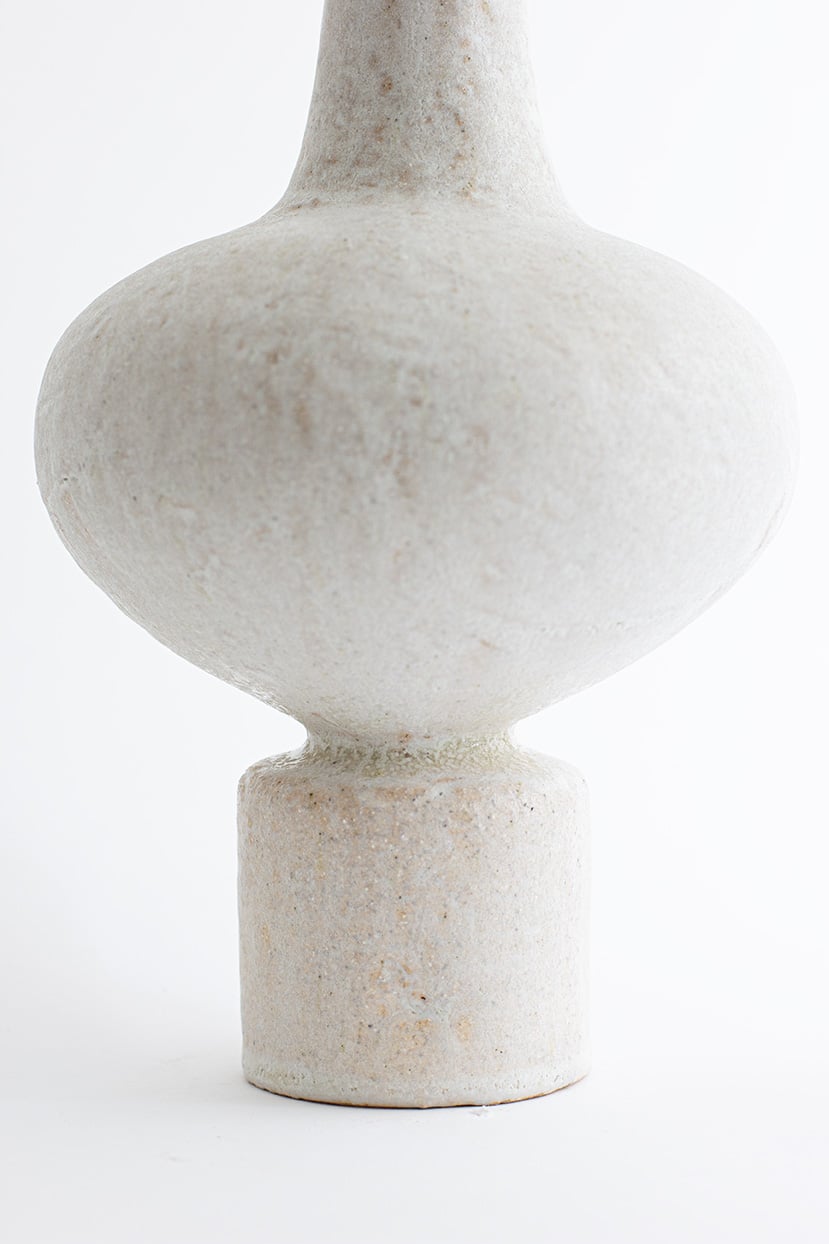
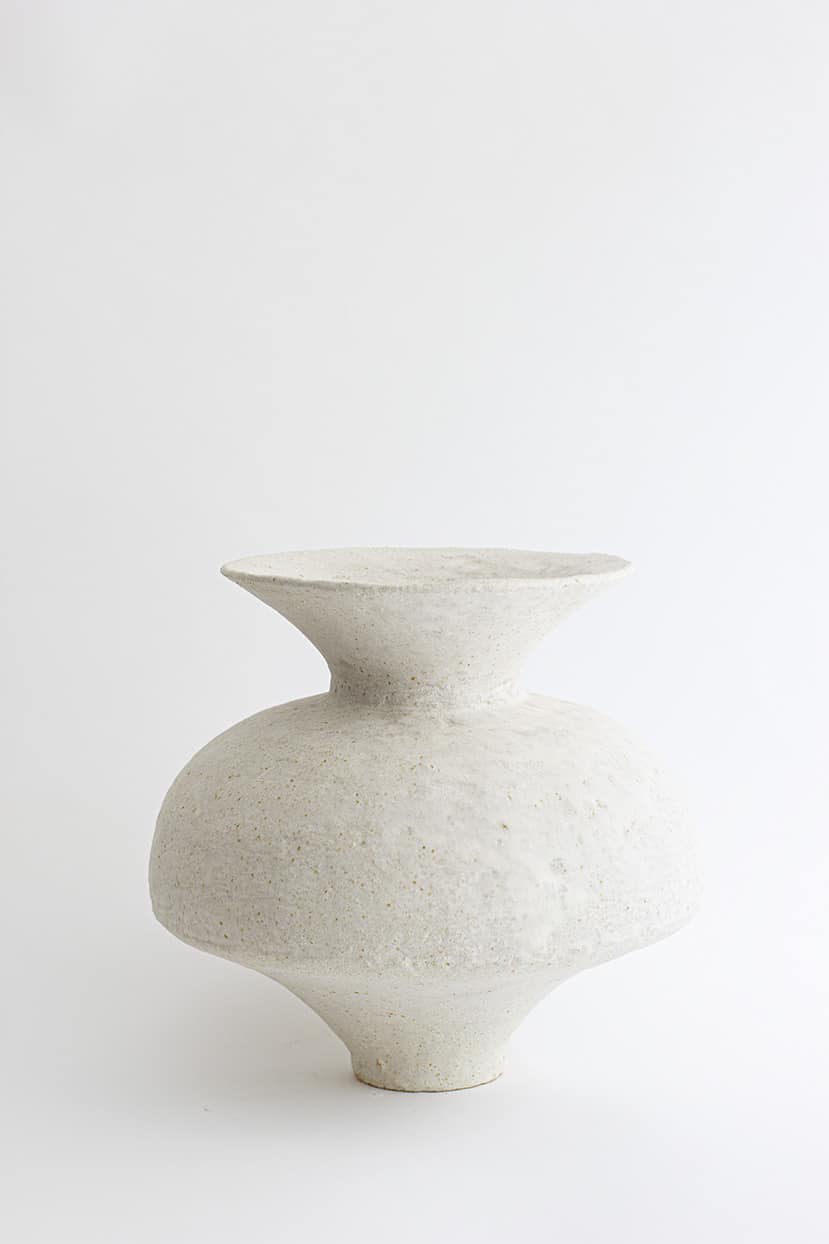
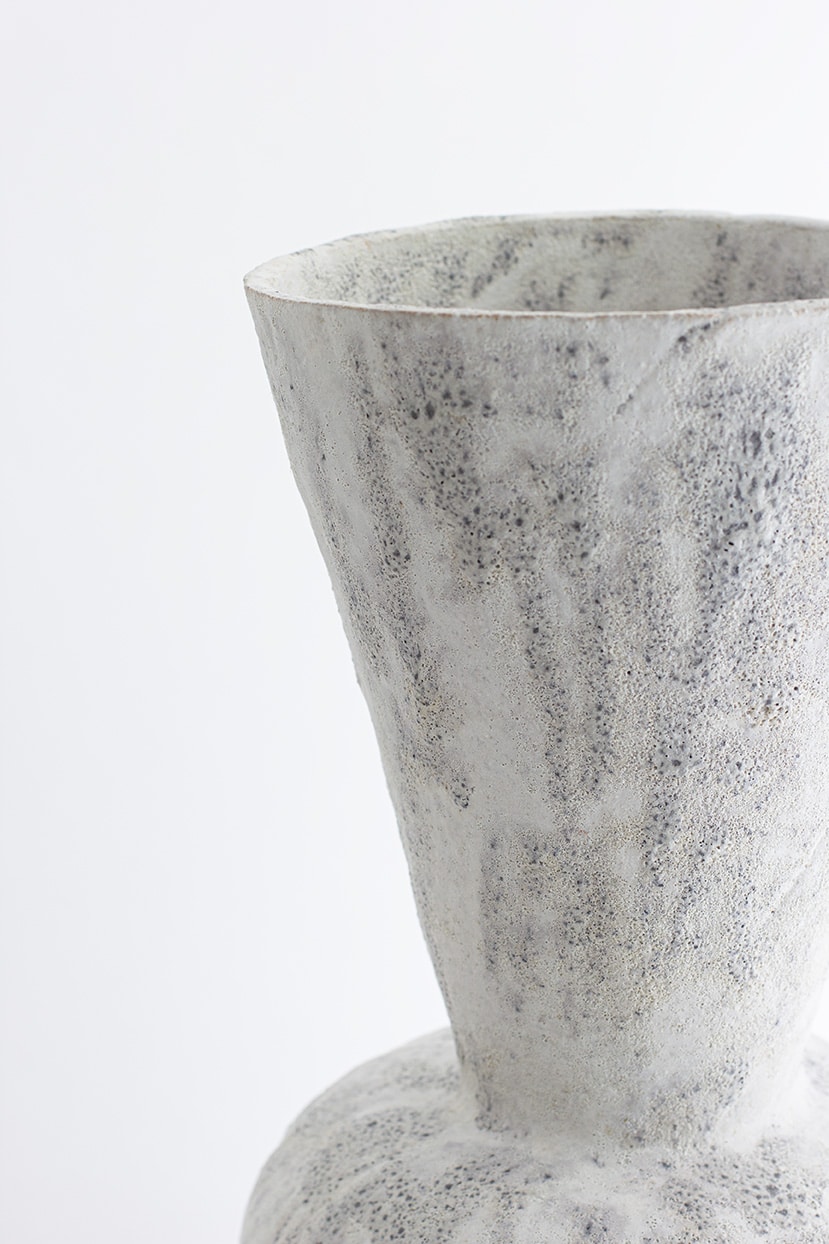
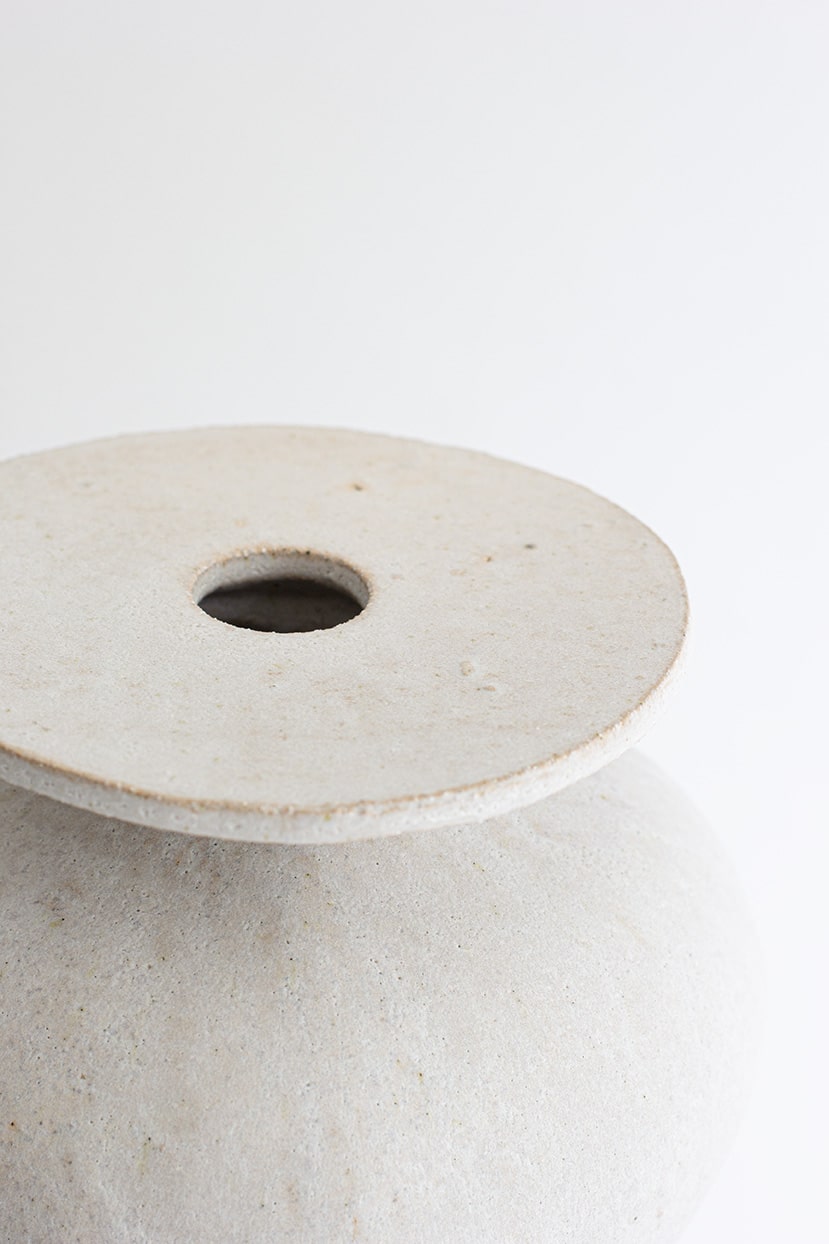
Ceramics and metal allow us to review ways from the past into the present, two trades that need a slow production time, which makes the observation and acquisition of small fragments indispensable for the creation of cartography. Experimentations with glazes, with natural beeswax and its subsequent casting process, experimentation with the shapes and hybridization of both materials are territories rich in processes which deserve to be observed and from which we obtain samples for our future study. This makes us feel like metal and clay archeologists.
What advice could you give to beginning artists who would like to create sculptural design works?
The time we spend on the project and each piece will remain very important to us. Our objects are born from always observing, thinking, and making, a gerund that accompanies us from the beginning of the project. This immersive temporality makes every step we take critically thought out and analyzed, learning from mistakes, and trying to maintain a consistent and more robust line of work every day that passes.
If your works had to belong to a design movement, how would you define it?
We prefer to think that our work is not defined by a concrete movement but is shaped by the sum of them, as a kind of palimpsest.
What designers and artists have influenced you?
Our focus has a strong naturalistic and historical character. We find the ancient forms and ancestral ways of production that interest us so much throughout different periods in history. We continually observe primitive designs produced with as few tools as possible, and above all, we pay special interest to Iberian, Roman, and Greek designs, which are an intrinsic part of our Mediterranean culture. Looking at what surrounds us, we find the textures, colors, and shapes that the natural world offers if you dedicate the right amount of time to observing it. This influence is mixed with the imagery of designers such as Lucie Rie, Hans Coper, Ewen Henderson, and Johannes Nagel.
What contemporary artists, in any kind of art, have you been inspired by?
Olafur Eliasson, James Turrell, Anish Kapoor, Gerhard Richter, Michael Müller, Allan McCollum, Rebeca Horn, LEUNORA SALIHU, Jenny Brosinski, THOMAS SCHÜTTE, PETER DOIG.
What contemporary designers do you appreciate?
Faye Toogood, TODOMUTA studio, Max Lamb, Vincenzo De Cotiis, Nacho Carbonel.
If you had to summarize your creations in one word or sentence, what would it be?
Cartographic drift.
“We build thinking and think about building.”
The Questionnaire
The Questions
(The Proust Questionnaire is a set of questions answered by the French writer Marcel Proust.
Other historical figures who have answered confession albums are Oscar Wilde,
Karl Marx, Arthur Conan Doyle, Stéphane Mallarmé, Paul Cézanne…)
What is your idea of perfect happiness?
Pedro: Morning, Raquel, André, and the smell of freshly brewed coffee.
Raquel: Calm, André’s smile, and Pedro’s warmth.
What is your greatest fear?
Pedro: Something bad happening to Raquel or André.
Raquel: Pedro or André suffering.
What is the trait you most deplore in yourself?
Pedro: On many occasions, I say “no” before even thinking.
Raquel: Believing that everything must happen when and how I want it to happen.
What is the trait you most deplore in others?
Pedro: Desidia.
Raquel: Non-listeners.
Which living person do you most admire?
Pedro: Raquel.
Raquel: Pedro.
What is your greatest extravagance?
Pedro: Eating spoonfuls of Nutella.
Raquel: In each of my meals, finishing with the perfect bite—combining the foods that I like the most in the last forkful.
What is your current state of mind?
Pedro: Ever since our son was born, more lucid than ever.
Raquel: Since our son was born, my brain is more primitive than ever.
What do you consider the most overrated virtue?
Pedro: Likes on social media.
Raquel: Likes on social media.
What is the quality you most like in a man?
Pedro: Intensity.
Raquel: The ability to be surprised.
What is the quality you most like in a woman?
Pedro: Intensity.
Raquel: The ability to be surprised.
Which words or phrases do you most overuse?
Pedro: —
Raquel: Cinco lobitos tiene la loba. (“The Wolf Has Five Cubs” – Spanish children’s song)
Which talent would you most like to have?
Pedro: To be able to make music.
Raquel: Play any instrument to start a band with Pedro and André.
If you could change one thing about yourself, what would it be?
Pedro: To be less grumpy.
Raquel: See less.
What do you consider your greatest achievement?
Pedro: To have the possibility to manage our own time.
Raquel: To give birth to André.
If you were to die and come back as a person or a thing, what would it be?
Pedro: If I could, I would repeat the same.
Raquel: As a person, the same. If I had to be an animal, I would be first a bird and then a cat.
Where would you most like to live?
Pedro: Frank Lloyd Wright’s Fallingwater.
Raquel: If Pedro lived in Frank Lloyd Wright’s Fallingwater, I’d go live with him.
What is your most treasured possession?
Pedro: My creativity.
Raquel: My brain.
What do you regard as the lowest depth of misery?
Pedro: Living without feeling someone else’s love.
Raquel: Not being in somebody else’s thoughts.
What is your favorite occupation?
Pedro: My occupation.
Raquel: My occupation too.
What is your most marked characteristic?
Pedro: My work ethic and my concentration.
Raquel: I’m curious about everything.
What do you most value in your friends?
Pedro: Empathy.
Raquel: Patience.
Who are your favorite writers?
Pedro: Borges and Raymond Queneau.
Raquel: Chantal Maillard and Virginia Woolf.
Who is your hero of fiction?
Pedro: I don’t have any heroes.
Raquel: Not any fictional ones.
Which historical figure do you most identify with?
Pedro: —
Raquel: —
Who are your heroes in real life?
Pedro: André. It’s amazing how he knew how to land in this world without anyone teaching him how to do it.
Raquel: André. It’s amazing how he knew how to land in this world without anyone teaching him how to do it.
What are your favorite names?
Pedro: Cleo and André.
Raquel: Cleo and André.
What is it that you most dislike?
Pedro: Lack of sensitivity.
Raquel: Not being heard.
What is your greatest regret?
Pedro: I don’t regret anything, but I would have liked to have learnt more languages.
Raquel: Not being better prepared for my breastfeeding.
How would you like to die?
Pedro: Immersed in a calm atmosphere.
Raquel: Sleeping.
What is your motto?
Pedro: At least, try.
Raquel: “‘No’ is already an option.”
“Our objects are born from always observing, thinking, and making.”
SHARE :